Insights · Scope & pricing · September 2026
Traffic guarantees and delivery guarantees promise different things
One SEO proposal says "30% more traffic in 90 days, or we keep working for free." Another says "the agreed work in your first month, or your first fee back." Both sound like a safety net. They protect you against different failures, and each only works if you know what it measures, what you must do and what you get if it fails.

A delivery guarantee covers the provider's own output: the work it agreed to do. A traffic guarantee covers an outcome that depends partly on things the provider doesn't control, so it always comes with conditions. Read the measure, your obligations and the remedy of each before you rely on it.
What each promise covers
A delivery guarantee is about the work. The provider commits to specific output in a set period, such as a number of accepted articles, completed technical fixes or a published report. If that work isn't done, you get a stated remedy, usually money back. The provider controls almost everything this promise depends on, so it can be simple.
A traffic guarantee is about a result. The provider commits to a measured change in visits from search, often a percentage over a period. Traffic also depends on your product, your competitors, search engines' changes, your own site releases and your tracking. So a traffic guarantee needs a baseline, a definition of what counts and a list of things you must do. Without those, nobody can say whether it was met.
Neither is better on its own. A delivery guarantee tells you the work will happen. A traffic guarantee tells you the provider expects that work to move a number, and is prepared to carry some of the risk.
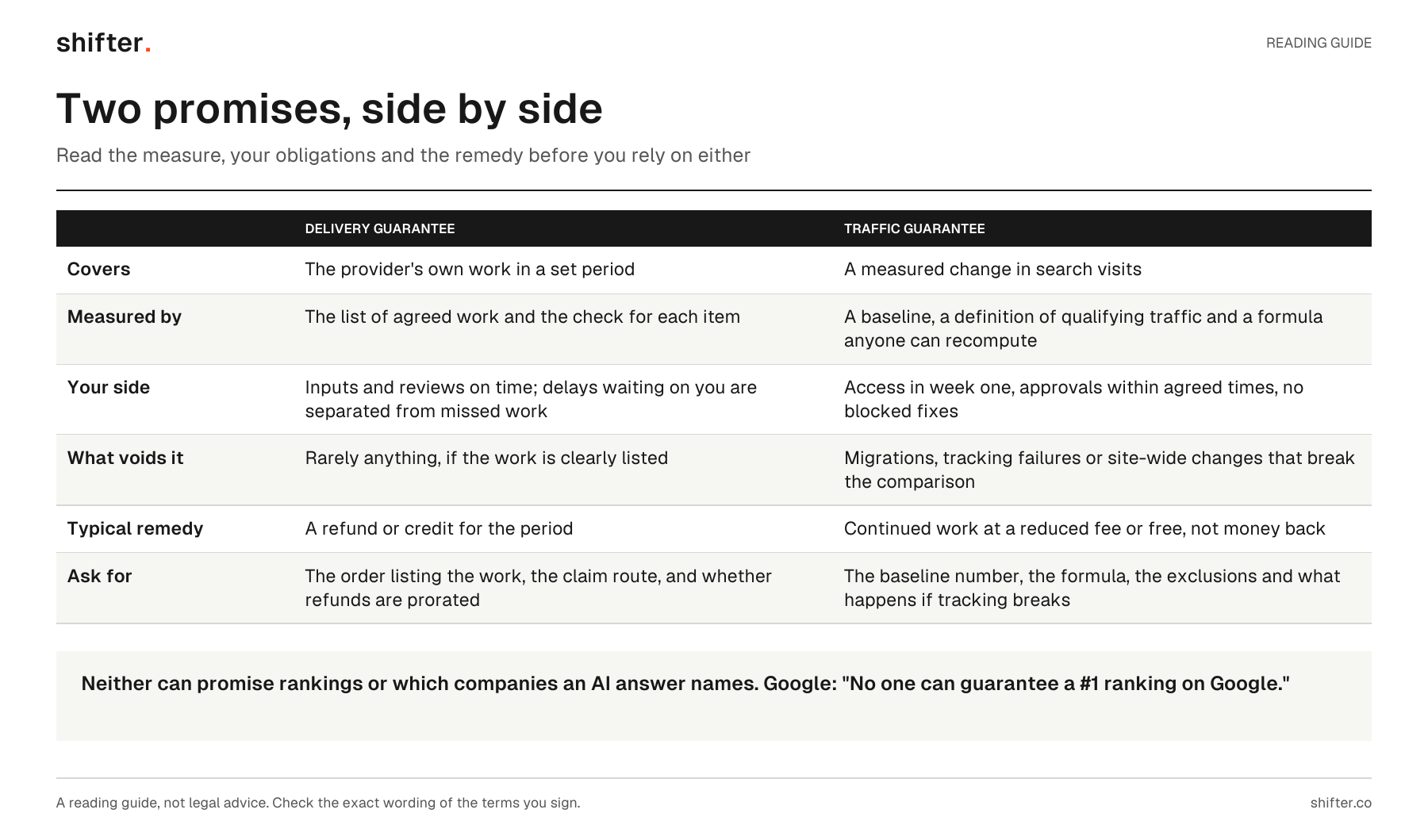
Read the visual as text
- Covers: delivery guarantee, the provider's own work in a set period; traffic guarantee, a measured change in search visits.
- Measured by: the list of agreed work and the check for each item; versus a baseline, a definition of qualifying traffic and a formula anyone can recompute.
- Your side: inputs and reviews on time, with delays waiting on you separated from missed work; versus access in week one, approvals within agreed times and no blocked fixes.
- What voids it: rarely anything if the work is clearly listed; versus migrations, tracking failures or site-wide changes that break the comparison.
- Typical remedy: a refund or credit for the period; versus continued work at a reduced fee or free, not money back.
- Ask for: the order listing the work, the claim route and whether refunds are prorated; versus the baseline number, the formula, the exclusions and what happens if tracking breaks.
- Neither can promise rankings or which companies an AI answer names. Google: "No one can guarantee a #1 ranking on Google."
Reading a delivery guarantee
Start with what counts as delivered. "Four articles a week" means little until you know whether a draft counts, or only an article that's been reviewed, approved and published. The best version lists the work and the check for each item in the order or contract you sign.
Then check four things:
- Which dates it covers, and when the clock starts: payment, kickoff or the day you grant access.
- Whether the remedy is a full refund of that month's fee, a partial one or a credit against future work.
- Who you tell to claim it, in what form, and what they'll compare your claim against.
- What happens when the delay is yours. If your expert misses a review date, that shouldn't count as the provider failing to deliver. A fair guarantee separates missed work from work waiting on you.
Reading a traffic guarantee
A traffic guarantee is only as good as its measurement. Ask for these in writing before work starts:
- What traffic counts: organic search only, or AI referrals too; which analytics property; which source and channel rules; and whether branded visits, careers pages or support pages are excluded.
- The baseline period and how many sessions it had. A tiny baseline makes a percentage easy to hit and meaningless.
- The formula. "30% growth" should mean something anyone can recompute: assessment sessions minus baseline sessions, divided by baseline sessions.
- What voids it. A site migration, a tracking failure or a redesign can break the comparison. A careful guarantee documents the effect with you instead of silently resetting the baseline.
- What you must do. Most traffic guarantees require access in the first week and approvals within agreed times. If you can't commit to those, the guarantee may not apply.
- The remedy. "We keep working for free" means more of the same service, not your money back. Decide whether more of the same work is what you'd want if the target were missed.
Consider a fictional example. A company's baseline is 1,000 qualifying sessions over 90 days, so a 30% target means 1,300. In week five, a site release breaks the analytics tag for ten days. The guarantee can't be judged on those numbers. A good contract says how that gap is handled and records it with you. A vague one leaves you arguing about what the traffic "would have been."
What neither guarantee can promise
No provider controls where a search engine ranks a page or which companies an AI answer names. Google's guide to hiring an SEO is blunt: "No one can guarantee a #1 ranking on Google." AI answers also change between runs of the same question, so a promise of "named in N AI answers" is hard to measure fairly and impossible for anyone to control. Treat a promise of specific rankings, or of a set number of AI mentions, as a red flag. Google's guide to hiring an SEO.
What a provider can promise is its own work, and, with a clear measurement agreement, a share of the risk on an outcome both sides can check.
A real example: Shifter's own terms
Shifter's service terms, checked on 25 September 2026, include both kinds:
- A delivery guarantee: if Shifter doesn't deliver the work agreed for the first 30 days, it refunds the first month's base service fee. The order records that work, its completion checks and the start date. A partial delivery doesn't reduce this to a prorated refund.
- A traffic guarantee, for qualified Gear 1 and Gear 2 clients only: Shifter commits to at least 30% growth in qualified organic and AI search traffic over the first 90 service days, compared with the prior 90-day baseline. If the target isn't reached while the agreed conditions are met, Shifter continues the base service without its management fee until it is. The client provides GA4, Search Console, CMS and technical access in week one. A major migration or tracking failure that invalidates the baseline has to be documented and resolved with the client.
Read the full wording in Shifter's terms and hold it to the same questions as any other provider's.
Questions to ask before you rely on either
Before signing, fill in one line for each promise: "It's met when ___, measured by ___, provided we ___; if it isn't, we get ___." Any blank you can't fill is a question for the provider. How to choose a B2B SEO agency covers the rest of the proposal. What your SEO report should show covers the evidence you'll need to check the guarantee each month.
FAQ
What is the difference between a traffic guarantee and a delivery guarantee?
A delivery guarantee covers the provider's own work, such as the articles or fixes agreed for a period, and usually refunds a fee if that work isn't done. A traffic guarantee covers a measured change in search visits, so it needs a baseline, a definition of what counts and conditions you must meet.
What should an SEO delivery guarantee cover?
It should list the work and the check that makes each item count as delivered, the period, the remedy and how to claim. It should also separate work the provider missed from work that was waiting on your team.
Can an SEO agency guarantee rankings or AI mentions?
No provider controls where a search engine ranks a page or which companies an AI answer names, and AI answers change between runs of the same question. Treat a promise of specific rankings or a set number of AI mentions as a red flag.