Insights · Choosing a partner · September 2026
How to choose a B2B SEO agency when every proposal sounds convincing
Two proposals promise content, technical SEO and AI visibility. One offers more articles. The other has a more persuasive strategy presentation. You still do not know who will understand your product, finish the work or explain a disappointing month.

Start by asking each agency to walk you through one finished piece of work, from the buyer question to the live page. Then take one claimed result and ask how it was measured. If you cannot tell who did the work or what the result means, keep that proposal open for clarification.
Compare what each proposal actually delivers
Consider these fictional proposal extracts:
Proposal A: Twelve researched article drafts, supplied each month for your team to approve and upload.
Proposal B: Eight articles, including product review, original diagrams, CMS entry, internal links and checks on the published pages.
If you have an editor and publishing capacity, A may fit the gap. If drafts already sit untouched in a shared folder, favor a scope that takes them through publication. Buying more drafts leaves that queue with your team.
Now inspect the ambiguous phrase in B: “product review.” Does the agency interview your expert, check the documentation or expect your product manager to rewrite every draft? Put the answer in the scope. Twelve and eight become meaningful quantities only after you know what has to happen around each article.
Ask both agencies to map the same article through their proposed process: who supplies the product facts, approves the copy, uploads it and checks the live page. Circle anything assigned to your team and check that someone has time for it. For each proposal, assign any step left without an owner before signing.
Do the same for technical work. A recommendation to repair a template is different from a completed repair. Name the person who implements it and the access or development time they need from you.
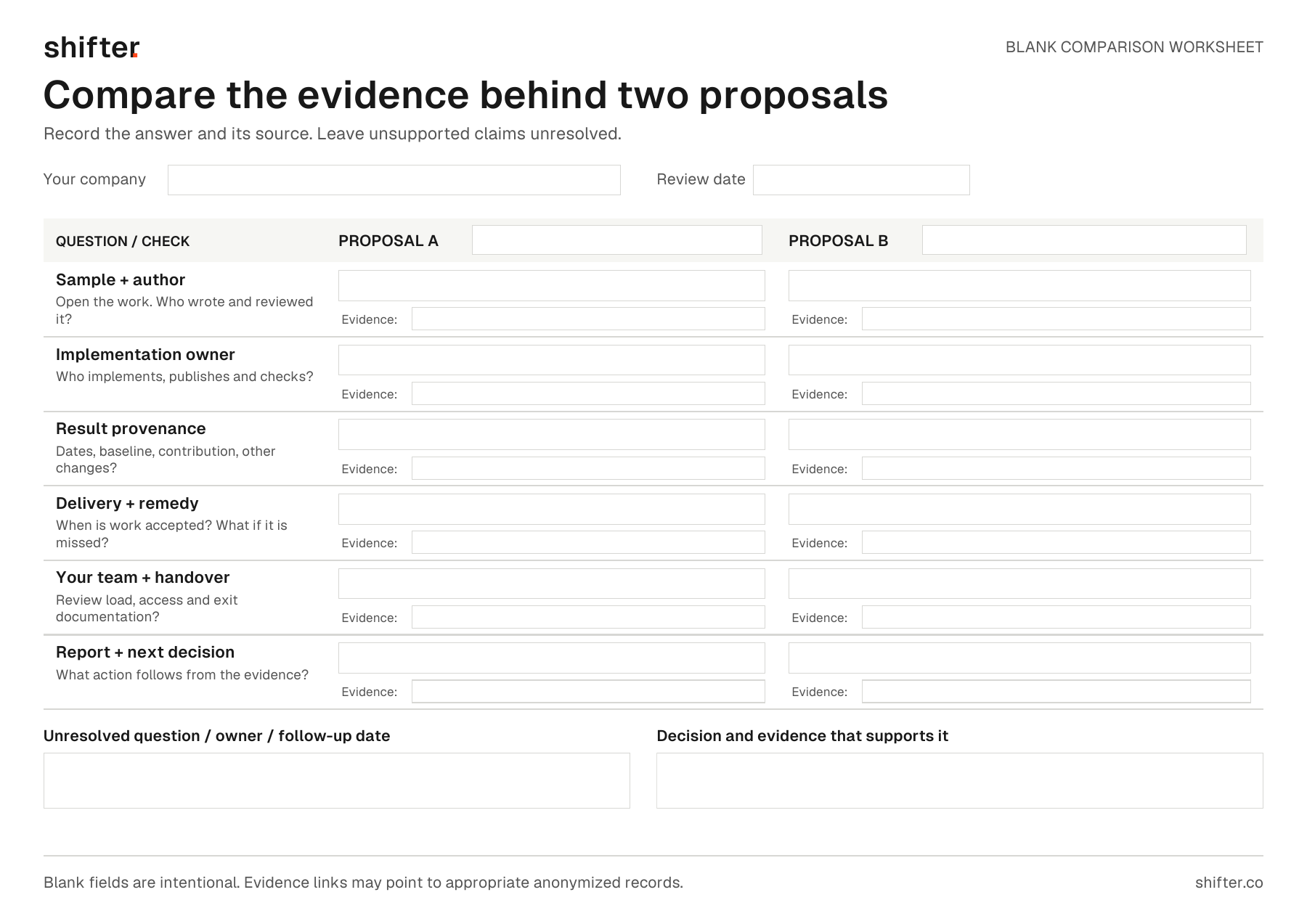
Read the visual as text
- Enter your company, review date and the names of Proposal A and Proposal B.
- For each proposal, record an answer and evidence link for: sample work and author; implementation owner; result provenance; delivery and remedy; your team and handover; report and next decision.
- Sample: open the work and identify who wrote and reviewed it. Implementation: name who implements, publishes and checks. Result: record dates, baseline, contribution and other changes.
- Delivery: define acceptance and what happens when work is missed. Client and handover: identify review load, access and exit documentation. Reporting: explain the action that follows from the evidence.
- Record the unresolved question, owner and follow-up date. Write the final decision and supporting evidence. Blank fields are intentional; no scores or agency rankings are prefilled.
Read a sample as a potential customer
Ask for a finished page close enough to your business that you can assess it. A software comparison, implementation guide or product explanation usually reveals more than a broad introduction to an industry term.
Look for the difficult details: who the product suits, what it cannot do, what adopting it involves and where a claim comes from. Pick one sentence that could affect a purchase, such as a claim about an integration or plan limit, and open its source. Check that it supports that exact claim. A citation about the general topic is not enough.
Ask who researched, wrote and reviewed the sample, and whether the proposed team will use the same process on your account. A strong sample from an unrelated team needs an explanation of how that quality will carry over.
Give shortlisted agencies the same small question about your site: which existing page would they investigate first, and what would they need to know? A thoughtful answer can name an uncertainty and explain how to resolve it. You are testing judgment, not asking for an unpaid strategy project.
Google's hiring guidance recommends discussing previous work, industry and geographical experience, communication and client references. Use those topics to make the conversation specific to your business. Google's guide to hiring an SEO.
Follow the result back to its evidence
A case study headed “organic traffic doubled” leaves several questions open. What were the starting and ending counts? Which dates, markets and pages were included? Was the growth relevant to the customer's product? What did the agency change during that period?
For a revenue claim, ask how the sale was connected to the work. A customer could have encountered the company through several channels before searching its name. Attribution needs an explanation, especially when the headline makes the agency sound solely responsible.
Other events also matter: a product launch, acquisition, new paid campaign or tracking change may explain part of the movement. You do not need unrestricted access to another company's analytics. An anonymized account of the method, supported by an appropriate reference, can make the result assessable without exposing confidential records.
A newer agency may lack comparable client outcomes. Assess the evidence it can provide: a researched sample, a documented implementation and a clear review process. Founder experience can help you judge commercial understanding, but running a business does not itself establish SEO results. Apply that distinction when reading Shifter's founder background.
Agree what happens when work is late or wrong
Take an ordinary failure through the proposal before it becomes your problem. An article contains an unsupported product claim and needs rewriting. Does the draft count toward delivery? Who corrects it? What happens to the next batch while the error is resolved?
Then reverse the dependency: your expert misses an agreed review date. Establish how that affects the schedule and who raises the blockage. Written answers make it easier for both sides to distinguish missed delivery from work waiting for input.
Read any guarantee alongside its measure, conditions and remedy. Google warns against a promise of first place in search results. A provider can commit to specified work and contractual remedies, but cannot control a search platform's future rankings or recommendations. Google's hiring guidance.
Finally, inspect a sample report. Ask which decision follows from it: continue a topic, repair a page, investigate a decline or wait for more evidence. A report that merely restates the activity list leaves you doing the diagnosis.
Record each proposal's sample, responsible people, evidence and unresolved commitments side by side. Before choosing, finish this sentence for each: “For this fee, the agency will complete ___; our team must provide ___; we will accept the work when ___.” Send any blanks back to the agency. Choose once you can explain the commitment to the people who will have to support it.
Our agency comparison can help you build a shortlist. Apply the same questions to every provider, including Shifter.
FAQ
What should I ask an SEO agency before signing?
Ask it to walk you through one finished piece of work, from the buyer question to the live page, then take one claimed result and ask how it was measured. Also ask who implements each task and what happens when work is late or wrong.
How do I check an agency's case study?
Ask for the starting and ending counts, the dates, markets and pages included, and what the agency changed during that period. For a revenue claim, ask how the sale was connected to the work, and check for other events such as a product launch or a tracking change.
Can an SEO agency guarantee rankings?
No provider controls a search platform's future rankings or recommendations, and Google warns against promises of first place. An agency can commit to specified work and contractual remedies, so read any guarantee alongside its measure, conditions and remedy.