Insights · Reporting · September 2026
What your SEO and AI search report should show
The monthly report says traffic is up. Your sales team says inquiries look much the same. Before renewing or increasing the budget, you need to know what changed and whether it matters to the business.

A useful report connects the work delivered to the buyers it reached, then explains the next decision. Four sections are enough to start, provided you can open the evidence behind them.
Work you can open and inspect
Start with the agreed scope. Ask for published URLs, changes to existing pages, completed technical fixes and live external coverage. Each item needs a date, its purpose and its status.
“Content production underway” tells you little. A published comparison page, its intended buyer question and a link to the reviewed work give you something to judge.
Keep unfinished work visible. Drafts, unanswered pitches and blocked fixes belong in the report with an owner and next step. They do not count as completed delivery. A linked brand mention may satisfy two categories, but it is still one placement.
Search progress tied to your buyers
Consider a fictional report: Search Console clicks to the reviewed pages rise from 100 to 150 across comparable periods. That is a 50% increase. But 45 of the 50 additional clicks go to a careers page after a recruitment announcement; clicks to pages aimed at prospective customers rise by five.
The total is accurate, yet it gives you little reason to expand the sales-focused content budget. Ask which pages and queries explain the movement. Separate brand searches from relevant searches that do not name you, break out target countries and mark events that affect the comparison.
Keep the measurement consistent. Search Console can aggregate by property or by page, so those totals can differ. Query filters also omit anonymized queries; a filtered non-brand total is not a complete census of demand. Google’s aggregation guide and filtering guidance explain these limits.
Search Console clicks and GA4 sessions measure different things. Report them alongside each other; adding them would count overlapping activity as extra traffic. Google’s explanation.
AI visibility: what was tested and observed
A useful AI report records the questions tested, platform, country, date, captured answers and cited URLs. It keeps these observations separate:
- Mention: your business is named.
- Recommendation: the answer suggests your business as an option for that question.
- Citation: the answer links to your website as a source.
Each rate needs a clear denominator. For recommendation coverage, use valid answers to questions where recommending a provider is relevant. A valid answer recommending nobody still counts. Keep general learning questions and questions that name your brand separate. Show missing or failed runs alongside the completed sample.
For example, a fictional test with four recommendations in 20 valid provider-selection answers has 20% recommendation coverage. If five additional runs failed, report those five as missing; counting them as negative answers would obscure the incomplete test. Compare the same questions, countries and platforms over time. These observations describe your test, not your share of every buyer using AI.
Google now documents a Generative AI performance report for AI Overviews and AI Mode impressions. Check whether it is available and populated for your property, and record the report, dates and filters used. Its documentation says it includes Web performance data, so do not add those impressions to Web totals as extra exposure. Impressions, captured AI answers and visits referred by AI tools need separate measures; none can stand in for the others.
Inquiries and sales, with their limits
Ask what happened after visitors arrived: accepted inquiries, qualified opportunities and paying customers. Agree what “qualified” means, then reconcile tracked events with inquiry, CRM and payment records. A form submission could be a buyer, a vendor pitch or a test; the event count cannot tell you which.
GA4 coverage depends on your consent setup. Some reports can include modeled data, but behavioral modeling has implementation and data-volume requirements; eligibility is not automatic. Ask the agency to state whether a figure is observed or includes modeling, and flag tracking changes. Google’s behavioral modeling documentation.
More traffic and more sales in the same month do not prove the agency caused the sales. The report should distinguish what was observed from the explanation being tested.
Treat an AI Overview “lost revenue” calculator as a scenario, not a record of money your business lost. A calculation using assumed click losses, conversion rates and conversion values does not observe those losses. Keep it outside measured business outcomes, show the assumptions and their sources, and leave unsupported inputs unknown rather than borrowing another site's results.
A report you can use
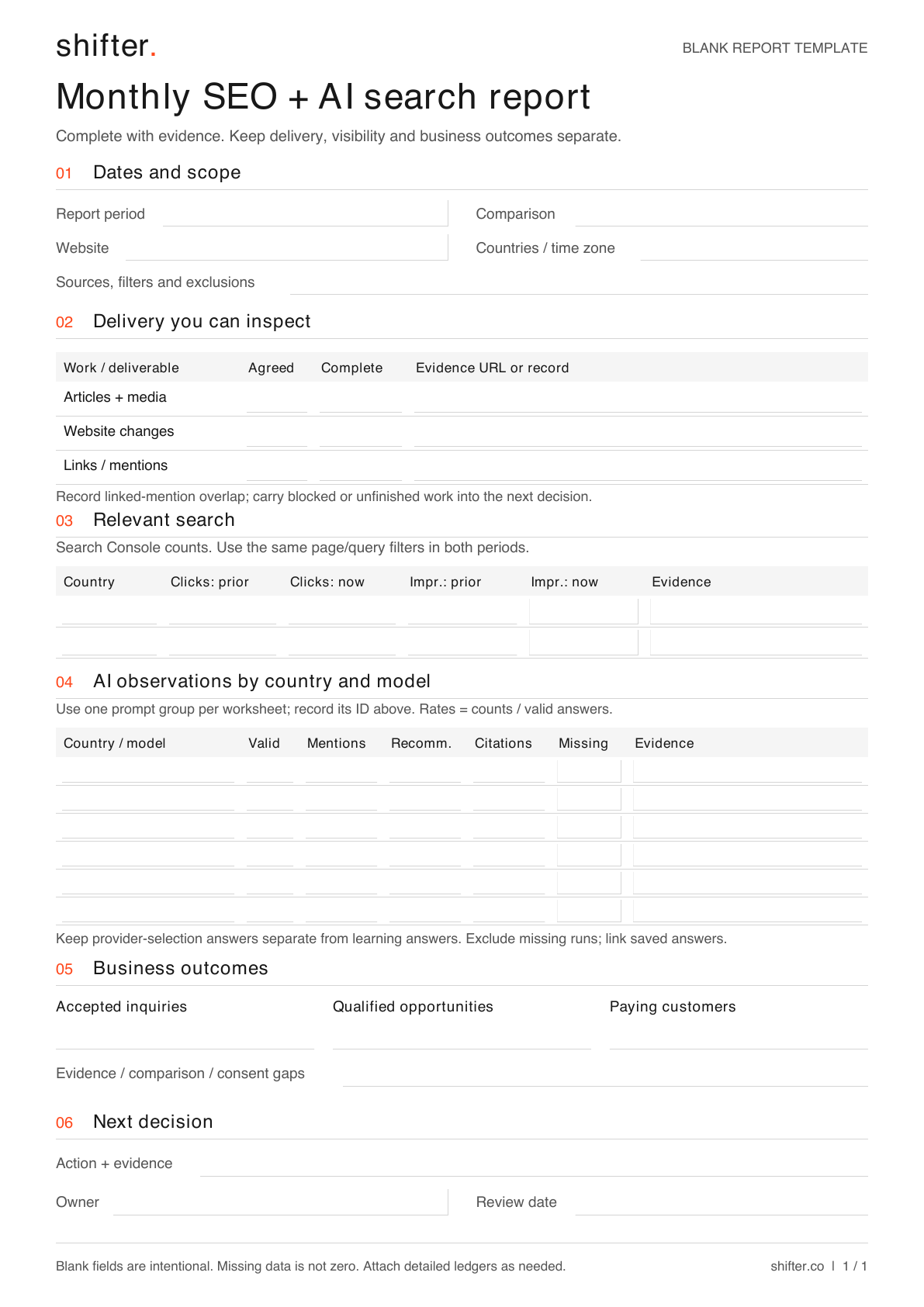
Copy this blank template. Add evidence links beside every completed item and reported figure.
| Section | This period | Comparison or next step |
|---|---|---|
| Dates and scope | [Dates, countries, pages, exclusions] | [Comparable period; changes to note] |
| Delivery | [Agreed / completed; URLs] | [Shortfalls, owner, due date] |
| Relevant search | [Clicks, impressions, query/page filters] | [Previous counts; explanation to check] |
| AI observations | [Mentions, recommendations, citations / valid answers] | [Same configuration; missing runs] |
| Business outcomes | [Accepted inquiries, qualified opportunities, paid customers] | [Previous counts; attribution/consent gaps] |
| Next decision | [Priority and evidence behind it] | [Owner, action, review date] |
Finish with a decision. If relevant impressions grow but inquiries do not, inspect the landing pages, offer and tracking before expanding production. If the data is too thin, say what additional evidence is needed.
Use the report to agree one action, its owner and a review date. Shifter’s measurement notes explain how we separate delivery, visibility and business evidence.
FAQ
What should a monthly SEO and AI search report include?
Four sections: the work delivered, with links you can open; search progress tied to the pages and queries your buyers use; AI visibility, with the questions tested and what the answers named or cited; and inquiries and sales, with their limits. End with one decision, an owner and a review date.
Can I add Search Console clicks and GA4 sessions together?
No. They measure different things, so adding them counts overlapping activity twice. Report them side by side.
How should AI visibility be measured?
Record the questions, platform, country, date, captured answers and cited URLs. Count mentions, recommendations and citations separately, each against a clear denominator, and show failed or missing runs instead of scoring them as zero.