Insights · Building your team · September 2026
SEO agency, freelancer or in-house hire: what does your SaaS team need?
Look at the last useful page your team planned but never published. Where did it stop? Nobody chose an angle, nobody had time to write it, or nobody could make the required website change?

That answer gives you a better starting point than comparing an agency fee with a freelancer's rate or an employee's salary. You need an arrangement that covers the missing work and leaves someone responsible for getting it finished.
The following three fictional SaaS teams show how to make that choice. They are examples of capacity gaps, not company stages you have to progress through.
Nobody owns the program
In the first team, the founder commissions an article about a broad industry trend. Sales wants a comparison page. Product wants to correct an old integration guide. All three jobs reach the same writer, with no decision about which matters most.
The writer is waiting for a priority; a larger writing allowance would leave that decision unresolved.
This team needs someone to own the program. An agency can provide research, planning and coordination if those responsibilities are included. An experienced independent consultant can also lead a defined program, bringing in production help where needed. Ask who will set priorities, chase missing inputs and coordinate publication.
The company still needs an internal decision-maker. Someone must explain the product, choose between business priorities and authorize access. Outsourcing does not remove those decisions; it changes who prepares them.
An in-house hire makes sense when there is enough continuing work to justify the role and close involvement with product, sales and leadership is central to doing it well. Before hiring, decide which capabilities the role requires and which will still need external support. One job title does not establish expertise in every part of search.
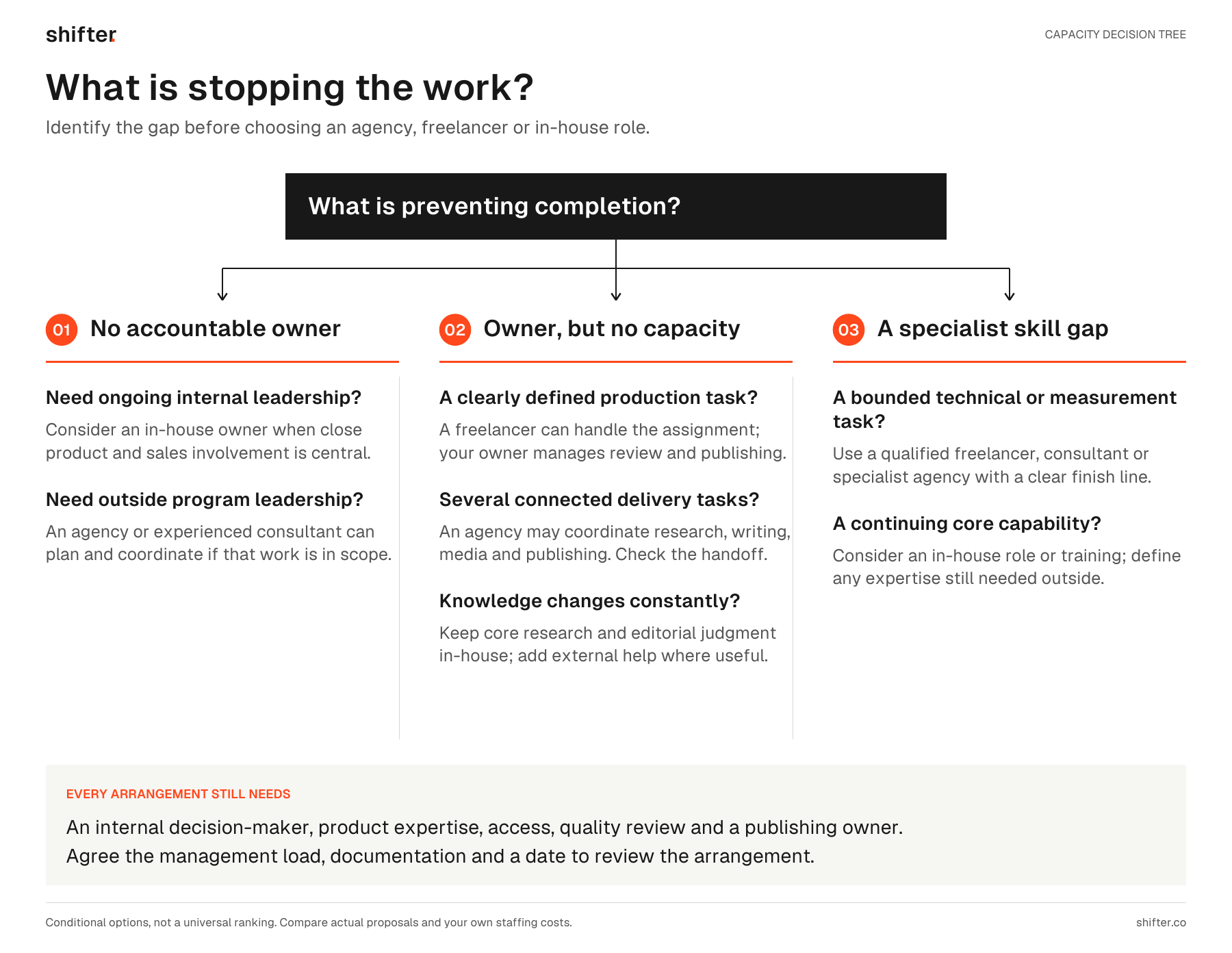
Read the visual as text
- Start: what is preventing completion?
- No accountable owner: consider an in-house owner when continuing work needs close product and sales involvement. An agency or experienced consultant can provide outside planning and coordination when that responsibility is included.
- Owner but no capacity: a freelancer can handle a defined task while the internal owner manages review and publishing. An agency can coordinate several connected delivery tasks if the handoff covers them. Keep core research and editorial judgment in-house when product knowledge changes frequently.
- Specialist skill gap: use a qualified freelancer, consultant or specialist agency for a bounded task with a clear finish line. For a continuing core capability, consider an in-house role or training and identify external expertise still required.
- Every arrangement needs an internal decision-maker, product expertise, access, quality review and a publishing owner. Agree management load, documentation and a review date. Compare actual proposals and your own staffing costs. No arrangement is universally best.
An owner exists, but production is the bottleneck
The second team has a marketing lead who knows the customer, maintains a useful topic plan and can judge a draft. Three approved briefs are waiting because that person also runs campaigns and supports sales. The priorities are clear; there is no writing capacity to act on them.
A freelancer can be a good fit for a clearly defined slice of this work: researching an article, designing an explanatory asset or editing product content. The internal owner supplies context, reviews the output and coordinates publication. This arrangement works best when the assignment and acceptance criteria are clear enough that every delivery does not require another planning meeting.
An agency becomes attractive when the bottleneck spans several connected tasks. Research, writing, editing, media and publishing may need coordination as well as individual contributors. Check where the package stops. A team delivering reviewed drafts and a team publishing complete pages are covering different gaps.
Shifter's Gear 1 offer, for example, combines articles with media, one-site optimization, a strategist and weekly written updates at $1,797 USD a month before applicable taxes, checked on 24 September 2026. Compare those responsibilities with the backlog; buying coordination makes sense only when you need it.
Keeping production in-house is sensible when the work depends heavily on frequent product changes or knowledge that is expensive to transfer. External writers may still help, but your team could reasonably retain research, technical review and editorial judgment.
The team needs a specialist to finish something
The third team already has a content owner, writers and a publishing process. It is moving to a new website platform, and nobody on the team can assess which URLs need redirects or verify them after the move. That is a specific capability gap.
Scope a project around that gap: the URL inventory, agreed redirect mapping, implementation responsibilities and checks after the move. Name the developer who can make the changes and agree what documentation the specialist will leave. A freelancer, consultant or specialist agency could each fit. A broad monthly retainer needs an explanation of the continuing work it would cover once the move is complete.
Google describes SEO services ranging from content and structural reviews to development advice, training and geographical expertise. That range is a useful reminder to hire for the capability you need rather than assuming every SEO provider offers the same thing. Google's hiring guide.
Compare the management work as well as the fee
Before comparing fees, take one planned article or fix through each proposed arrangement. Who briefs it? Who answers product questions? Who checks it and gets it live? Add the internal time those handoffs require to your comparison. A lower external fee may be sensible when your team has that capacity; it becomes harder to justify when the same employee is already holding up the work.
Consider continuity too. Ask where briefs, source notes, account access and unfinished work will live. A freelancer can document work thoroughly; an agency can still leave you dependent on one person. Evaluate the handover arrangement itself.
After the first batch or project milestone, review which tasks still stalled, how much time your team spent on handoffs and corrections, and whether responsibilities need to change. You may retain strategy internally and buy production, or use outside leadership while an employee develops the capability. If you are considering Shifter, meet the founder and bring us the work your team cannot currently finish.
FAQ
Should a SaaS company hire an SEO agency, a freelancer or an in-house marketer?
Start from where the work stalls. If nobody owns the program, you need ownership: an in-house lead, or an agency or consultant with that responsibility in scope. If an owner lacks production capacity, a freelancer or an agency can add it. If one specialist job needs finishing, scope a bounded project.
When is a freelancer the right choice?
When an internal owner already sets priorities, reviews the work and gets it published, and the task is clearly defined, such as researching an article, designing an explanatory asset or editing product content.
Does outsourcing SEO remove work from my team?
No. Someone inside still has to explain the product, choose between priorities, authorize access and review the output. Compare the management time each arrangement needs, not just the fee.