Insights · Content planning · September 2026
How to find buyer questions when your website has little traffic
You open Search Console to plan content, and there's almost nothing there: a few dozen clicks a month, most of them on your own brand name. The keyword tool shows zero volume for the phrases your buyers use. That doesn't mean nobody asks. It means you're looking in the wrong places for a site your size.

On a small B2B site, the best buyer questions come from conversations you already have: sales calls, demo requests, support tickets and onboarding. Search data and AI answers then tell you how those questions are phrased and what already answers them. Record where each question came from, and mark what you don't know as unknown.
Why search data is thin on a small site
Search Console only shows searches where your pages appeared, so a new or small site sees few. It also hides rare searches. Google explains that "some queries (called anonymized queries) are not included in Search Console data to protect the privacy of the user making the query," and that these are queries not "issued by more than a few dozen users over a two-to-three month period." Google Search Central. Specific B2B questions are often exactly that rare.
Keyword tools have a similar blind spot. A question asked by 20 potential customers a month can be worth more to you than a phrase searched thousands of times, but it may show little or no volume at all.
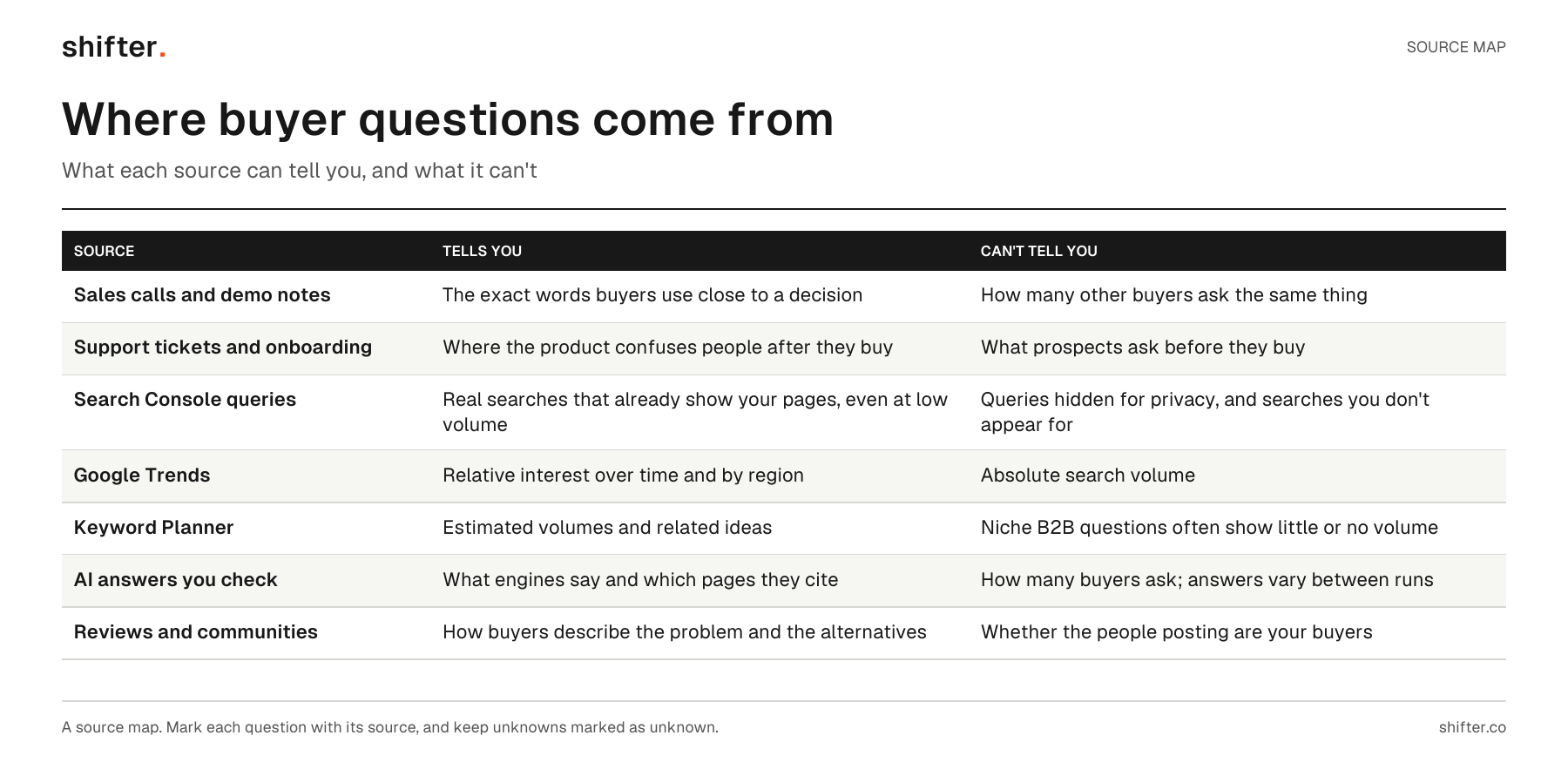
Read the visual as text
- Sales calls and demo notes: tell you the exact words buyers use close to a decision; cannot tell you how many other buyers ask the same thing.
- Support tickets and onboarding: where the product confuses people after they buy; not what prospects ask before they buy.
- Search Console queries: real searches that already show your pages, even at low volume; not queries hidden for privacy, or searches you don't appear for.
- Google Trends: relative interest over time and by region; not absolute search volume.
- Keyword Planner: estimated volumes and related ideas; niche B2B questions often show little or no volume.
- AI answers you check: what engines say and which pages they cite; not how many buyers ask, and answers vary between runs.
- Reviews and communities: how buyers describe the problem and the alternatives; not whether the people posting are your buyers.
Start with the conversations you already have
These sources are small, but they hold your buyers' own words:
- Sales calls and demo notes. Listen for the questions prospects ask before they're convinced: how it compares with an alternative, what setup involves, whether it works with a tool they already use.
- Demo-request forms. A free-text field such as "What do you want to solve?" collects questions in the buyer's words.
- Support tickets and onboarding. These show where the product confuses people after they've bought, which often mirrors what the next buyer will ask.
- Lost deals. The reason a deal went elsewhere is often a question your site didn't answer.
Write each question down in the buyer's wording, with where and when you heard it. One exact quote from a sales call is more useful than a paraphrased theme.
Then check how the question is asked elsewhere
Once you have a list, use outside sources to check wording and competition, not to replace the list:
- Search Console, even with little data. Look at the queries that do appear for your pages, including those with impressions but no clicks.
- Google Trends. It shows relative interest over time and by region, not volume: its numbers "are then scaled on a range of 0 to 100 based on a topic's proportion to all searches on all topics." Google Trends Help. Use it to compare two phrasings, not to size demand.
- Keyword Planner, part of Google Ads, offers keyword ideas and a "Get search volume and forecasts" option. Google Ads Help. Treat its figures as estimates, and expect gaps for niche phrases.
- AI answers. Ask ChatGPT or Perplexity the question in the buyer's words. See what the answer says, which companies it names and which pages it cites. Answers vary between runs, so save the date and the answer.
- Reviews and communities. Reviews of your product and your competitors, and threads where your buyers ask each other for advice, show how they describe the problem.
A fictional example
A billing tool for small accounting firms has 40 clicks a month in Search Console, almost all branded. Its founder spends an hour on the last 20 demo-call notes and finds the same four questions: whether it imports from the firm's current practice software, how long switching takes, whether clients can pay by bank transfer, and what happens to historical invoices.
None of the four shows search volume in a keyword tool. In an AI answer to "best billing software for small accounting firms," two competitors are named, and the cited pages are their integration and migration guides. That's enough evidence to write the first two pages, on importing and on switching, without any search volume at all.
Keep a simple source map
For each question, record four things: the buyer's wording, where it came from, what outside sources show, and what's unknown. "Unknown: how many buyers ask this" is an honest entry. It stops a guess from turning into a fact three meetings later.
When you have 15 or 20 questions, how to choose the next six topics covers how to pick which to write first. What buyers need on a SaaS product page covers the questions your product pages should answer before any article does.
FAQ
How can we find buyer questions before our website has much search traffic?
Start with the conversations you already have: sales calls, demo-request forms, support tickets, onboarding and lost deals. Then use Search Console, Google Trends, Keyword Planner and AI answers to check how each question is phrased and what already answers it.
Why doesn't Search Console show the questions our buyers ask?
It only shows searches where your pages appeared, so a small site sees few. It also leaves out anonymized queries, which Google describes as searches not issued by more than a few dozen users over two to three months. Many specific B2B questions fall into that group.
Is search volume the best way to choose B2B topics?
Not on its own. Many valuable B2B questions show little or no volume in keyword tools. A question you hear on sales calls every week is usually stronger evidence than a high-volume phrase nobody on your calls uses.