Insights · Content planning · September 2026
How to choose the next six topics for a B2B SaaS website
You have 40 topic ideas: some from a brainstorm, some from a keyword tool, a few copied from a competitor's blog. You can publish six well this month. Picking the six that sound most interesting is how most content calendars fill up with pages nobody needed.

Score every candidate on four questions: do your buyers actually ask it, how close is it to a buying decision, can you answer it with something others can't, and do you already have a page for it? Pick the six with the strongest evidence and the closest to a decision. Make sure at least one draws on something only your team knows.
Start from evidence, not ideas
For each candidate, write down where it came from. A question a prospect asked on a sales call last week is strong evidence. So is a support ticket that comes up every month, or a query already showing in your Search Console. A topic that "seems relevant" or appears on a competitor's blog is a guess until you find a buyer asking it.
Rewrite each topic as the buyer's question, in their words. "Integration strategy" becomes "Does it work with our CRM without a developer?" If you can't write the question, the topic isn't ready. How to find buyer questions when your website has little traffic covers where to look.
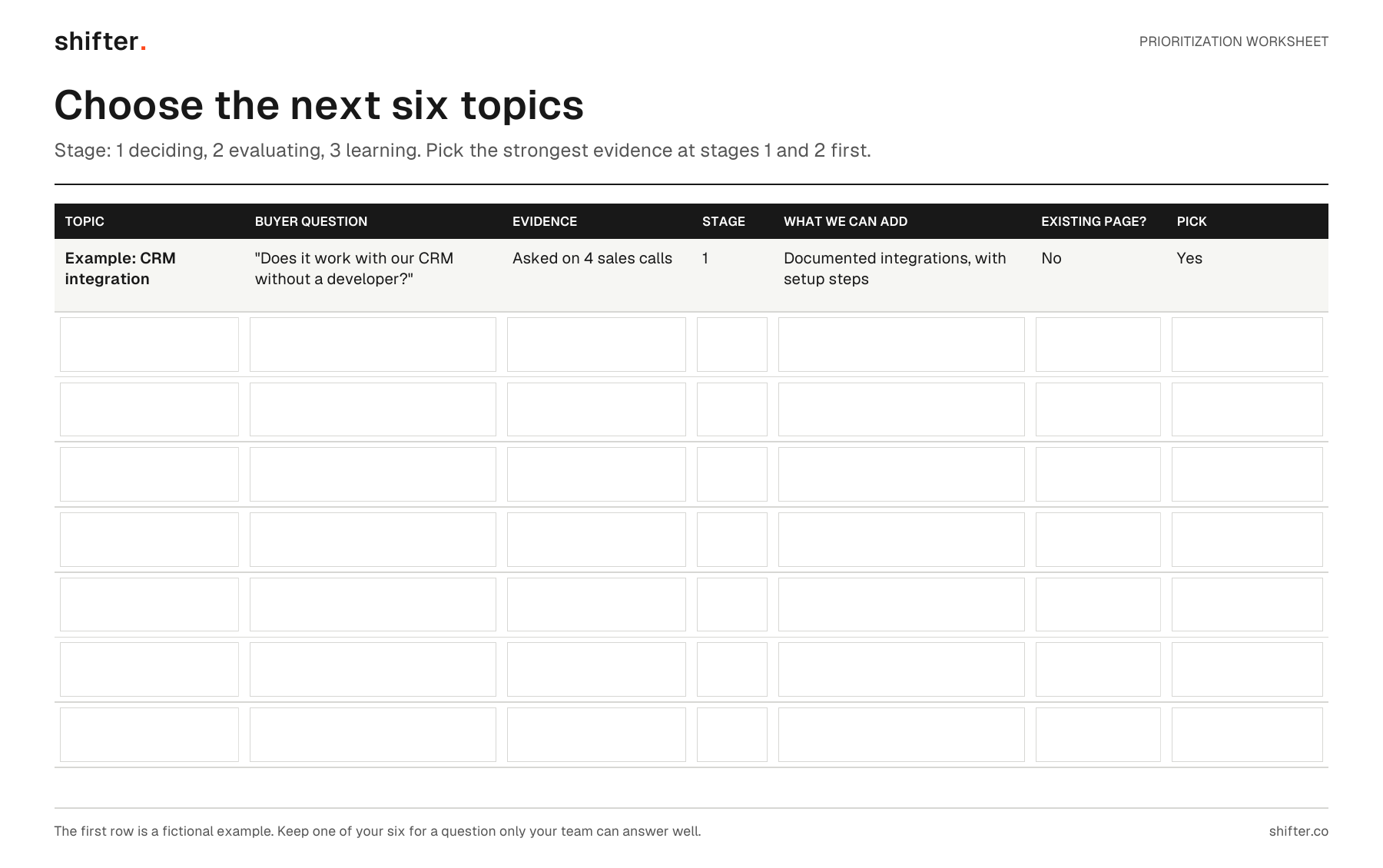
Read the visual as text
- Columns: topic, buyer question, evidence, stage (1 deciding, 2 evaluating, 3 learning), what we can add, existing page, pick.
- Fictional example row: CRM integration; "Does it work with our CRM without a developer?"; asked on 4 sales calls; stage 1; documented integrations with setup steps; no existing page; picked.
- Seven blank fillable rows follow. Pick the strongest evidence at stages 1 and 2 first, and keep one of the six for a question only your team can answer well.
Score how close it is to a decision
Not every question is worth the same to you. A buyer comparing you with an alternative, checking pricing or asking how implementation works is close to a decision. A buyer asking what a category means is further away.
Use three levels:
- Deciding: comparisons, alternatives, pricing, implementation, security and integration questions.
- Evaluating: how to solve the problem, what to look for, what it costs to do nothing.
- Learning: definitions and general background.
A small team usually gets more from the first two. Learning topics have their place, but they rarely belong in the first six.
Check what you can add
For each question, look at what already answers it: search results, and what AI answers say when you ask it. Then ask what your page could add that isn't there. Google's guidance on helpful content asks whether a page provides "original information, reporting, research, or analysis." Google Search Central.
For a software company, the original part is often close at hand: how your product handles the problem, a worked example with real steps, what you see across customers, or an honest account of when your product isn't the right fit. If the only thing you can add is a rewrite of what already ranks, move the topic down the list.
Check the pages you already have
Before writing something new, search your own site. If a page already covers the question badly, updating it may do more than publishing a second page on the same thing. Two pages that answer the same question compete with each other and split whatever attention either would have had.
The worksheet
Put every candidate in one table and fill in the columns before choosing:
| Topic | Buyer question | Evidence | Stage (1–3) | What we can add | Existing page? | Pick |
|---|---|---|---|---|---|---|
| CRM integration | Does it work with our CRM without a developer? | Asked on 4 sales calls | 1 | The documented integrations, with setup steps | No | Yes |
Then choose. Take the strongest evidence at stages 1 and 2 first. Break ties by what you can add. Keep one slot for a question where your team's first-hand knowledge makes the page clearly better than what exists.
A worked, fictional example
A scheduling tool for field-service teams has 12 candidates. Four come from sales calls, three from support tickets, two from Search Console and three from a keyword tool. Its six picks:
- "Does it work with our existing CRM?" Sales calls, stage 1, with documented integrations to show.
- "How long does it take to roll out to 50 technicians?" Sales calls, stage 1, with real onboarding steps.
- "[Competitor] vs [us] for teams under 100." Sales calls, stage 1, with an honest fit table.
- "Why do technicians miss appointment windows?" Support tickets, stage 2, with patterns from the product.
- "What does scheduling software cost for a small team?" Search Console, stage 1, with published pricing.
- "Update: our existing pricing page." Search Console shows impressions but few clicks, so the update comes before new articles.
The three keyword-tool topics were general definitions with no buyer asking them. They stay on the list for later.
Then sequence the six
Order the six by what each one needs. A topic waiting on a product expert's interview goes later in the month, so book the interview now. Link each new page from the pages buyers already reach, such as the pricing page or a related guide, so both people and search engines can find it.
If you're deciding whether you can afford more than six a month, when to increase your SEO budget covers the checks. Thirty articles a month covers how to judge each page once it's written.
FAQ
How should a B2B SaaS company choose which topics to publish first?
Score each candidate on whether buyers actually ask it, how close it is to a buying decision, what you can add that isn't already out there, and whether you already have a page for it. Start with the strongest evidence among decision and evaluation questions.
Should we pick SEO topics by search volume?
Not on its own. On a small or new site, many valuable B2B questions show little or no measured volume. Evidence from sales calls, support tickets and Search Console usually says more about what your buyers need.
Should we update an existing page or write a new one?
If a page already covers the question but does it badly, updating it often does more than publishing a second page on the same question. Two pages that answer the same question compete with each other.