Insights · Content quality · September 2026
Thirty articles a month: how to tell whether you're buying useful content
Thirty articles a month sounds useful when your website barely answers the questions prospects ask on sales calls. It looks less useful when the first batch gives you ten versions of the same advice and a product claim your team has to correct.

Establish what one finished article must do for its reader and what review it must pass. Ask the agency to take one representative article through its complete process. Choose a topic that requires knowledge of your product and customers. A polished introduction to a broad industry term will reveal less about its ability to handle your work.
Follow one brief all the way through
Consider a fictional example: a company selling customer-onboarding software commissions an article about handing customers from sales to implementation. Its intended reader is an operations lead who keeps discovering promises after the contract is signed.
The brief should identify the decision the reader needs to make: what information must move between teams, who confirms it and how exceptions are handled. It should also name the evidence the writer needs, such as an approved handover process and verified product documentation.
“Write 1,500 words about customer onboarding” leaves those decisions unresolved. Ask the writer to explain what this article will let the reader do and why an existing page cannot already do that job.
Now inspect a passage. Here is a weak passage:
A seamless handover empowers teams to delight customers and accelerate success.
A stronger version gives the reader something to apply:
Before the handover meeting, record the customer's intended outcome, promised integrations, agreed dates and unresolved questions. Give each open commitment an owner. Ask the implementation lead to flag any promise the delivery team cannot yet confirm.
Now give that passage a difficult case. In this brief, sales has promised an integration that implementation has not confirmed. The article could show an example handover entry: “Integration requested; feasibility unconfirmed; implementation lead to review before a delivery date is agreed.” That is a useful addition because it explains what happens when the information is incomplete.
The product expert still needs to confirm whether this process is appropriate. The writer cannot quietly turn a suggested practice into a claim that the software enforces it.
Useful media should carry some of that explanation. For this example, a handover diagram could show which information moves from sales to implementation and where a missing commitment stops the process. Check that the diagram and article agree. Give readers a text equivalent so the instructions remain usable without the image.
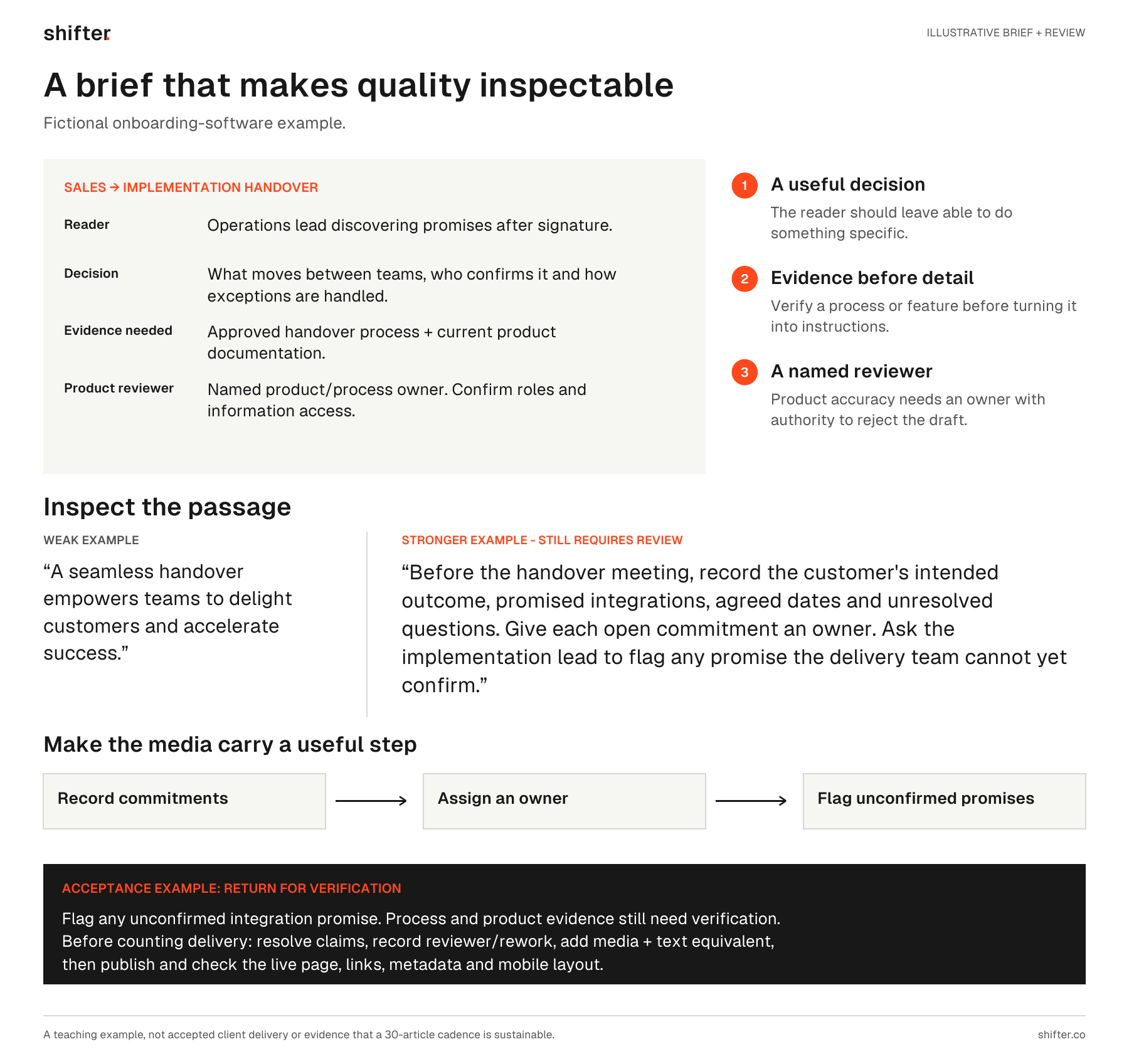
Read the visual as text
- Fictional teaching example: an onboarding-software article about sales-to-implementation handover. It is not client work or an observed result.
- Reader: an operations lead discovering promises after signature. Decision: what information moves between teams, who confirms it and how exceptions are handled.
- Evidence required: an approved handover process and current product documentation. Reviewer: a named product/process owner who verifies roles and appropriate access to information.
- Weak passage: A seamless handover empowers teams to delight customers and accelerate success.
- Stronger passage: Before the handover meeting, record the customer's intended outcome, promised integrations, agreed dates and unresolved questions. Give each open commitment an owner. Ask the implementation lead to flag any promise the delivery team cannot yet confirm.
- Media flow: record commitments, assign an owner, flag unconfirmed promises.
- Acceptance decision: return for verification. Flag any unconfirmed integration promise; process and product evidence still need verification. Before counting delivery, resolve claims, record reviewer and rework, add media and an accessible text equivalent, then publish and check the live page, links, metadata and mobile layout.
Ask to see the checks behind the prose
Suppose the next paragraph claims that the software “automatically transfers every sales commitment into the onboarding plan.” A linked help page only describes importing contact fields. The source does not establish what the sentence promises. Hold that claim for verification or remove it; a relevant-looking citation is insufficient.
Use the same test for consequential numbers, pricing and comparisons in the sample. Ask who checked each claim and when. Customer results need traceable evidence, and a founder's experience needs their confirmation. Preserve the source notes so a reviewer can inspect the reasoning without researching the entire article again.
Ask who reviews product accuracy and who has the authority to reject a draft. You should also know how much input your team must supply. Thirty pieces needing an unexpected product-manager rewrite represent a different workload from thirty pieces arriving ready for an informed final review.
AI can help with parts of production, but you still need evidence of those checks. Google's guidance emphasizes accuracy, relevance and quality, including metadata and image descriptions. It does not make the generation method a substitute for review. Google's generative AI guidance.
Google's scaled-content policy concerns producing many pages primarily to manipulate rankings without helping users. It applies regardless of how the content is created. A monthly quantity alone cannot establish whether the work meets that standard. Scaled content abuse policy.
Agree what earns a place in the delivery count
Turn the sample review into an acceptance agreement. In our example, the article remains in review while the integration claim is unresolved. Once corrected, it still needs its handover diagram, final approval and a working published page. Count it when that whole agreed job is finished.
Retain the buyer question, source notes, reviewer, revisions, media and final URL together. That record makes it possible to revisit an error without guessing which version was approved.
Check the actual page on a phone, follow its links and confirm that its title and description match the content. A correct document can still become a broken or unreadable page during publication.
Then inspect the batch as a whole. Put the titles beside the decisions they support. If three articles answer essentially the same question, ask whether one stronger page would serve the reader better. Resolve the resulting delivery gap explicitly rather than filling it with paraphrases.
Record the time spent on research, editing, product review, media and corrections. Compare early batches before assuming the process can maintain its pace. A useful content program needs enough capacity to complete the checks it promises.
Use the approved sample and its acceptance criteria as the standard for the first batch.
FAQ
How can I tell whether a 30-article-a-month program is useful?
Ask the agency to take one representative article through its full process, from brief to published page, on a topic that needs knowledge of your product. Check the brief, the source behind each consequential claim, who reviewed it and whether the live page works.
When should an article count as delivered?
When the whole agreed job is finished: claims verified, the reviewer recorded, media and a text equivalent added, and the page published and checked on a phone. A draft still waiting on verification doesn't count.
Does Google penalize AI-assisted content?
Google's guidance judges accuracy, relevance and quality. Its scaled-content policy targets many pages made mainly to manipulate rankings without helping users, however they are created. You still need evidence that each piece was checked.