Insights · Channels · September 2026
SEO or paid search: which bottleneck are you trying to solve?
Your board wants more pipeline from search, and you have one budget line. One agency pitches SEO. Another pitches Google Ads. Both show charts that go up and to the right. The better question isn't which channel wins in general. It's which of your problems each one solves.

Paid search buys a place in the ad slots for searches you choose, and you pay when someone clicks. SEO builds pages that can earn a place in the ordinary results, and it takes months and steady production. Pick by the bottleneck: if you need buyers this month on queries you already know convert, start with ads. If you need to be found for questions your buyers ask and have no page for, start with SEO.
What each channel actually buys
With Google Ads, you choose the searches, write the ad and set a budget. Under cost-per-click bidding, Google says, "you'll pay only when someone actually clicks on your ad and comes to your site." Google Ads Help. The ads appear quickly, and they stop when the budget stops. Google labels them: advertisements "will always be labeled with 'Sponsored' or 'Ad' and shown separately from search results." How Google Search works.
The ordinary results can't be bought. Google states that it "doesn't accept payment to rank pages higher, and ranking is done programmatically." Google Search Central. A place there comes from having the page that best answers the search. That's slower to build, but a page that ranks keeps attracting visits without a per-click cost.
So the two buy different things. Ads buy immediate visibility on searches you already understand. SEO builds pages for searches you want to be found for over time.
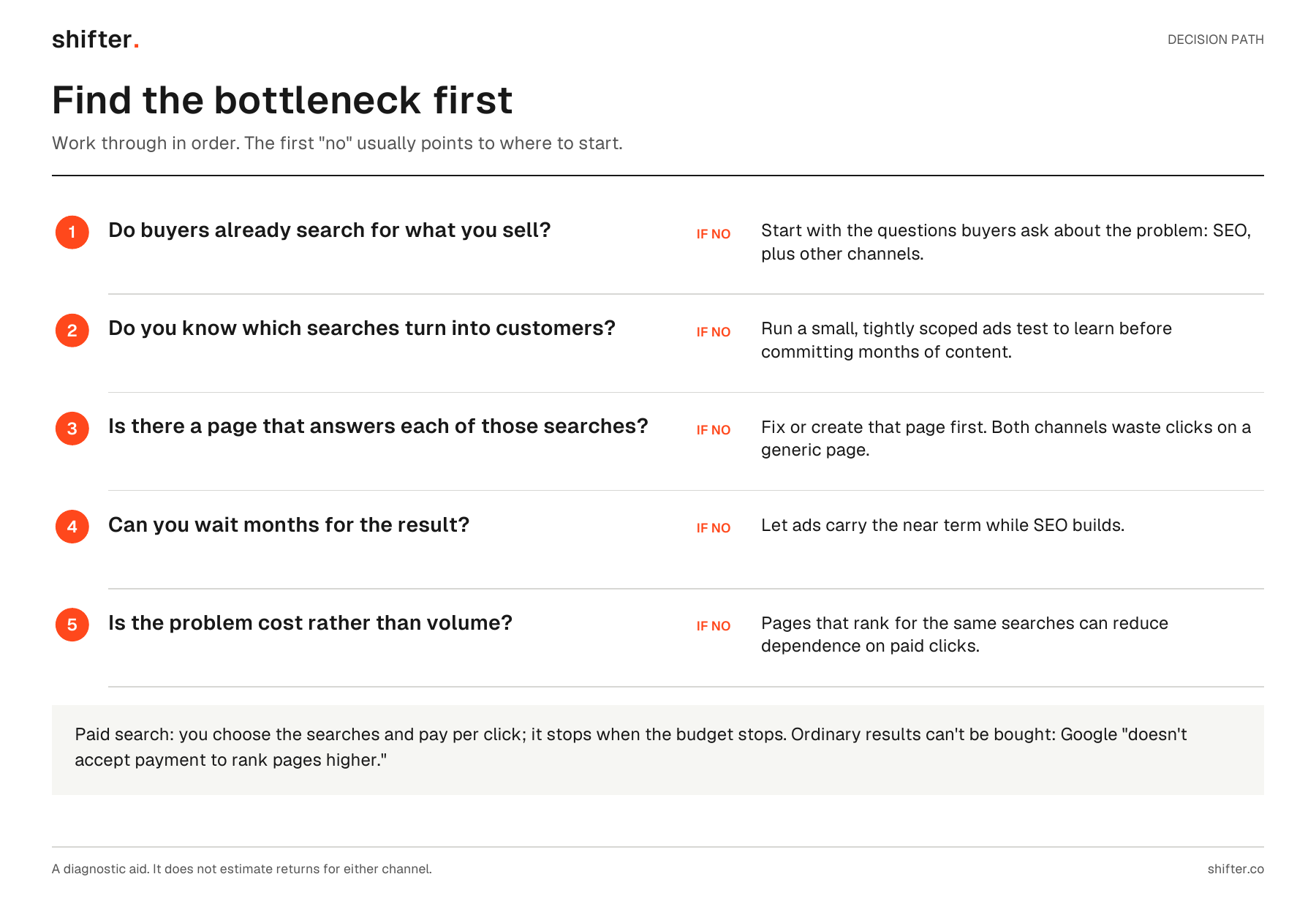
Read the visual as text
- 1. Do buyers already search for what you sell? If no: start with the questions buyers ask about the problem, SEO plus other channels.
- 2. Do you know which searches turn into customers? If no: run a small, tightly scoped ads test to learn before committing months of content.
- 3. Is there a page that answers each of those searches? If no: fix or create that page first; both channels waste clicks on a generic page.
- 4. Can you wait months for the result? If no: let ads carry the near term while SEO builds.
- 5. Is the problem cost rather than volume? If yes: pages that rank for the same searches can reduce dependence on paid clicks.
- Paid search: you choose the searches and pay per click, and it stops when the budget stops. Ordinary results cannot be bought: Google "doesn't accept payment to rank pages higher."
Find the bottleneck first
Work through these questions in order. The first "no" usually points to the channel.
- Do buyers already search for what you sell? If your category is new and nobody searches its name yet, neither channel has much to work with on those terms. Start with the questions buyers ask about the problem, which is SEO territory, and with other channels.
- Do you know which searches turn into customers? If yes, ads can buy more of those searches right away. If no, a small, tightly scoped ads test is the fastest way to learn, before you commit months of content to the wrong topics.
- Do you have a page that answers each of those searches? If a buyer clicks an ad or a result and lands on a generic homepage, both channels waste money. Fixing or creating that page comes first. What buyers need on a SaaS product page.
- Can you wait months for the result? If pipeline must move this quarter, ads carry the near term while SEO builds. If you can wait, SEO's cost doesn't rise with every click.
- Is your problem cost, not volume? If ads already work but each customer costs too much, pages that rank for the same searches can reduce how much you depend on paid clicks.
Use the data you already have
If you run both, link Google Ads and Search Console. Google's paid and organic report then shows, search by search, where you appear in ads, in the ordinary results or both. It requires the link: "you must have your Search Console account linked to your Google Ads account." Google Ads Help.
That report answers practical questions. Which searches do you pay for that you already rank well for? Which searches convert on ads but have no organic page? Those second ones are strong SEO candidates, because you already know buyers act on them.
A fictional example
A SaaS company gets almost all of its search clicks from its own brand name. It spends on ads for three category terms, and one of them produces most of its demo requests. It has no page that explains how the product compares with the alternatives buyers mention on sales calls.
The ads are working on one term, so it keeps that campaign and cuts the two that aren't. The missing comparison page is the bottleneck for both channels. It becomes the first SEO project, and it also gives the remaining ad a better landing page. Neither channel "won." Each solved a different part of the problem.
When to run both
Most B2B software companies end up running both, with a clear job for each. Ads test and harvest known demand. SEO builds pages for the questions buyers research before they're ready for a demo. Review them together every month: move budget toward whatever the evidence supports, not whatever the last report made look good.
Before you choose, write down the bottleneck in one sentence: "Buyers searching ___ can't find ___ on our site." If you can fill it in, you know where to start. SEO agency, freelancer or in-house hire helps with who does the work once you've decided.
FAQ
Should a SaaS company invest in SEO or paid search?
Pick by the bottleneck. Paid search buys immediate visibility on searches you already know convert, and it stops when spending stops. SEO builds pages for the questions buyers ask, takes months and doesn't charge per click.
Can you pay Google to rank higher in the ordinary results?
No. Google says it doesn't accept payment to rank pages higher, and ranking is done programmatically. Ads are labeled "Sponsored" or "Ad" and shown separately from the ordinary results.
How do I see where paid and organic results overlap?
Link Google Ads and Search Console, then open the paid and organic report. It shows, search by search, whether you appear in ads, in the ordinary results or both.