Insights · Your website · October 2026
What a useful SaaS comparison page includes
On a demo call, a prospect says they're down to you and one other tool, and asks why they should pick you. Your site's comparison page is a feature grid, with a check mark in every row on your side and gaps in most rows on theirs. The prospect has seen it, and it settled nothing. What should the page include so a buyer can use it?

A useful comparison page helps a buyer who has narrowed to a few options work out which one fits. It compares products that meet the same need, on the criteria buyers weigh, with a source and a check date for every fact about each product. Where the other option is the better choice, it says so. It discloses your interest and explains how you know what you claim.
What the buyer is doing when they open it
Most readers arrive with a short list. G2, which sells visibility on its review site, surveyed 1,169 B2B decision makers in April 2025 and reported that "Shortlists continue to shrink." G2 Buyer Behavior Report. A page that only argues for you can't help that reader rule an option in or out.
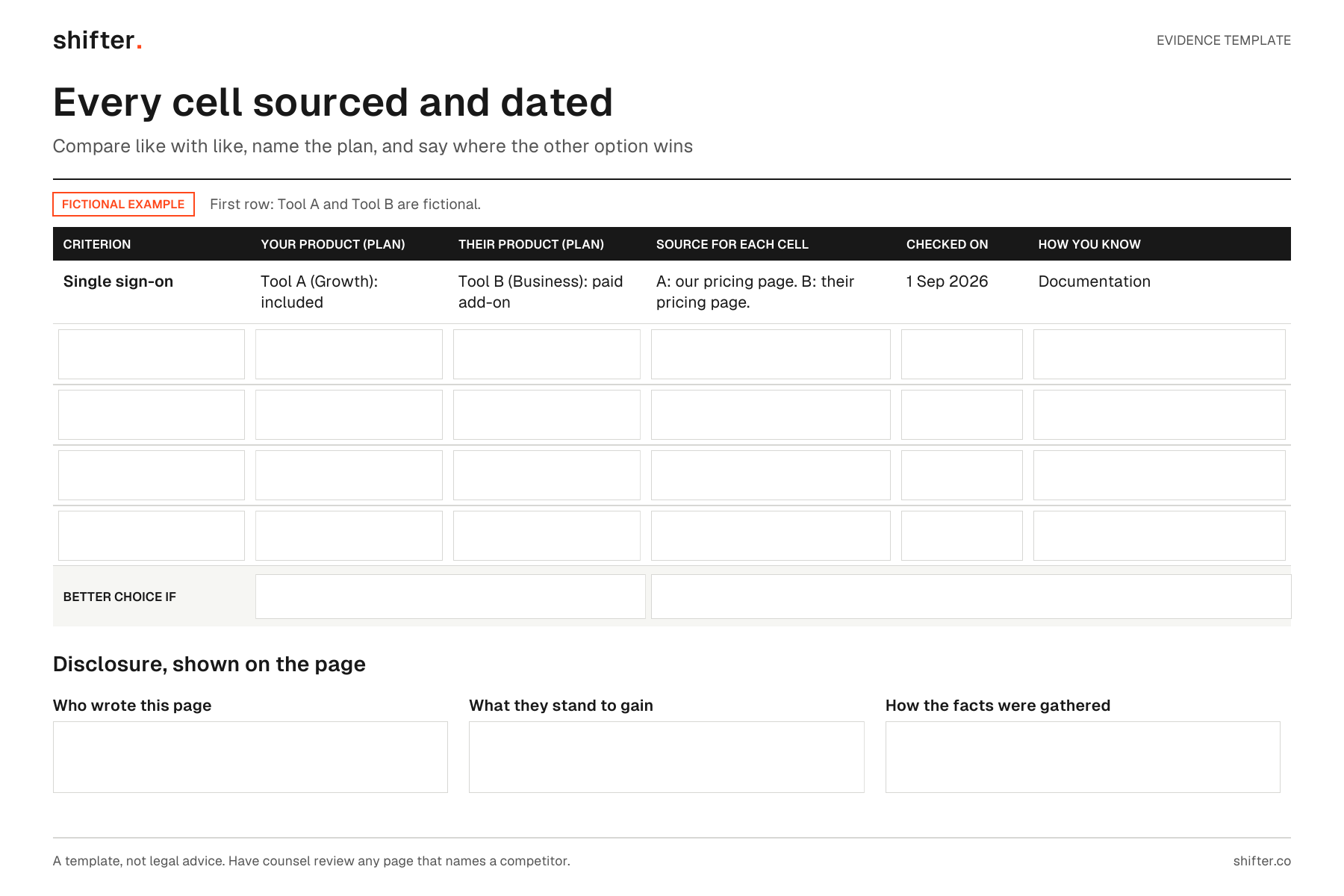
Read the visual as text
- Columns: criterion; your product with its plan; their product with its plan; the source for each cell; the date checked; how you know (hands-on use, a demo or the documentation).
- Fictional example row: single sign-on; Tool A on its Growth plan includes it; Tool B on its Business plan sells it as a paid add-on; sources are each pricing page; checked 1 September 2026; from the documentation.
- Four blank fillable rows, then a "better choice if" row with one field for your product and one for theirs.
- Disclosure fields shown on the page: who wrote it, what they stand to gain, and how the facts were gathered.
Start with the criteria buyers weigh
Google's guidance on reviews asks writers to "Cover comparable things to consider, or explain which might be best for certain uses or circumstances." Google Search Central. Nielsen Norman Group's comparison-table guidance says content matters more than design, and rows should be the attributes users care about. Nielsen Norman Group
Take the criteria from your sales calls, not a competitor's page. On our calls, buyers comparing providers ask about:
- What you deliver each month for the price
- Proof it works
- How results are measured
- Who actually does the work
- How easy it is to leave
- What's guaranteed
Compare like with like
Compare products that meet the same need, and name the plan or tier you compared. A starter plan against a competitor's top tier tells the reader nothing.
In the UK, the Business Protection from Misleading Marketing Regulations 2008 permit comparative advertising only when listed conditions are met, including that it "objectively compares one or more material, relevant, verifiable and representative features of those products, which may include price." legislation.gov.uk. The UK advertising code adds that the products must meet the same needs. CAP Code, section 3. In the US, the FTC calls truthful comparative advertising "a source of important information to consumers" and supports brand comparisons "where the bases of comparison are clearly identified." FTC
The FTC statement and the UK code both use consumer wording, and we found neither addressing B2B software directly. This isn't legal advice; have counsel review any page that names a competitor.
Source and date every fact
Every objective claim, about your product or theirs, needs evidence before it goes live. The FTC's guide for small businesses says a reasonable basis "means objective evidence that supports the claim." FTC
Keep the evidence with the table. For each row, record in a few words what each product offers, the source for each cell, the date you checked it and how you know (hands-on use, a demo or the documentation). We found no standard re-check interval, so pick a date and keep to it. NN/g recommends static tables of about five products, with every cell filled for every product. Nielsen Norman Group
A fictional example
Two fictional products, Tool A (yours) and Tool B, sell expense-approval software to finance teams. Tool A's table:
| Criterion | Tool A (Growth plan) | Tool B (Business plan) | Source, checked 1 Sep 2026 |
|---|---|---|---|
| Single sign-on | Included | Paid add-on | A: our pricing page. B: their pricing page. |
| Multi-currency approvals | Yes | Yes | A: our help center. B: their help center, not tested. |
| Accounting integrations | 2 | 6 | Both integration directories |
| Better choice if | You need single sign-on on a mid-tier plan | You need many accounting integrations | Our judgment, from the rows above |
Every cell has a source. The last row says plainly where Tool B wins.
Say where the other option wins, and disclose your interest
Google's review guidance asks writers to "Discuss the benefits and drawbacks of something, based on your own original research," and, if you call something the best, to "include why you consider it the best, with first-hand supporting evidence." Google Search Central. Its helpful-content questions ask about "expertise that comes from having actually used a product or service." Google Search Central. Say who wrote the page, what they stand to gain and how each fact was gathered. Keep the tone factual; the UK code says comparisons "must not discredit or denigrate another product." CAP Code, section 3
Our own list of AEO and GEO agencies is a vendor-written comparison. Shifter's founder wrote it and put Shifter first. A note at the top says so and explains that the order reflects whose site it is, not a neutral score. Nine other entries now carry a "Better choice than Shifter if" line. Its descriptions are dated, but it isn't a sourced table, so confirm its claims about other agencies with them.
Markup and AI answers
Google says "Structured data isn't required for generative AI search, and there's no special schema.org markup you need to add." Google Search Central. If you use review markup, Google says to "Provide review information about a specific item, not about a category or a list of items," and "Don't aggregate reviews or ratings from other websites." Google Search Central
In Fractl's analysis of Ahrefs Brand Radar data, covering 10,108 AI answers on marketing and SEO queries, "X vs. Y" comparison pages were about 1% of classified citations. Fractl. It covers one topic area. Treat it as a caution, and write for the buyer on your call. Once that buyer picks you, what buyers need on a SaaS product page covers the page they land on next.
FAQ
What should a SaaS comparison page include?
Products that meet the same need, compared on the criteria your buyers weigh, with every fact sourced and dated. The page should say where the other option is the better choice, who wrote it and how each fact was gathered.
Can we name competitors on our comparison page?
The FTC supports truthful comparisons where the basis is clearly identified. UK rules allow comparative advertising when listed conditions are met, including objective, verifiable features and no denigration. This isn't legal advice, so have counsel review any page that names a competitor.
Does a comparison page need schema markup to appear in AI answers?
Google says no special schema.org markup is needed for its generative AI features. If you use review markup, apply it to one item rather than a list, and don't pull in ratings from other websites.