Insights · Links & mentions · October 2026
What makes a backlink relevant to your SaaS business?
A site owner offers a paid link to your HR software from their page "25 digital marketing tips," and quotes a high domain score. Your agency's report could count that as a backlink. Would it help your business, and should it count?

A backlink is relevant when your buyers would read the page it sits on, the link appears where a reader would plausibly follow it, its anchor describes the page it points to, and it was earned or honestly marked as paid. Check the link's code yourself. Google doesn't publish a relevance score, so judge a placement as your buyer would. A paid link is advertising, so mark it rel="sponsored" and never count it as earned.
What Google says about links, and what it doesn't
Google defines the problem by purpose: "Link spam is the practice of creating links to or from a site primarily for the purpose of manipulating search rankings." Google's spam policies. Its documentation doesn't define a "relevant backlink" or say how many you need. The closest is anchor text: "Good anchor text is descriptive, reasonably concise, and relevant to the page that it's on and to the page it links to." Google Search Central.
Domain Rating, Domain Authority and similar scores come from SEO tool vendors. Google says: "No third-party tool has access to our internal ranking or AI systems." Google Search Central. Log any score a seller quotes as that vendor's estimate, with the tool's name. It doesn't measure the link's value to you.
Some tools say Google weights same-topic links more, though Ahrefs' help center says "no one can tell you exactly how search engines measure the quality of backlinks." Ahrefs Help Center. No Google document we found treats relevance as a ranking factor, yet it's still the right test of usefulness to your buyers.
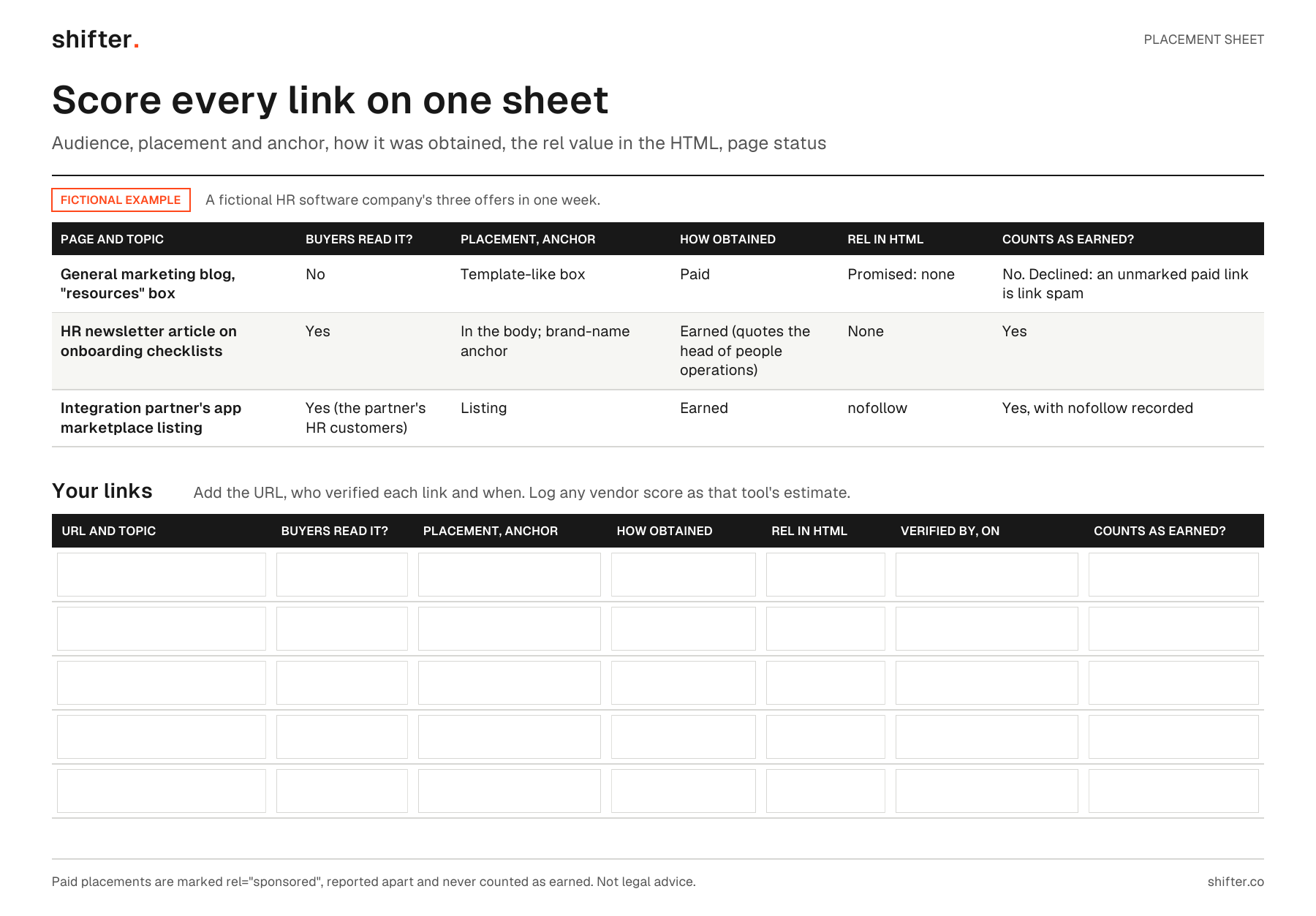
Read the visual as text
- Fictional HR software company. A general marketing blog offers a paid link in a "resources" box, promised without nofollow: buyers do not read it, the placement is template-like, and an unmarked paid link is link spam, so it is declined.
- An HR newsletter article on onboarding checklists quotes the head of people operations and links with the brand name in the body: buyers read it and it was earned, so it counts.
- An integration partner's app marketplace listing, read by the partner's HR customers, carries rel="nofollow": it counts as earned, with the nofollow value recorded.
- Blank fillable rows: URL and topic, whether buyers read it, placement and anchor, how it was obtained, the rel value in the HTML, who verified it and when, and whether it counts as earned.
- Paid placements are marked rel="sponsored", reported apart and never counted as earned.
When a link is paid for
Google accepts that "buying and selling links is a normal part of the economy of the web for advertising and sponsorship purposes." Google's spam policies. It asks for a label: "Mark links that are advertisements or paid placements (commonly called paid links) with the sponsored value." Links marked sponsored, ugc or nofollow "will generally not be followed." Google Search Central. Unlabeled paid links count as link spam, as does this example from Google's list: "Sending someone a product in exchange for them writing about it and including a link". Google's spam policies.
A bought followed link can also waste money. Google says SpamBrain "can now detect both sites buying links, and sites used for the purpose of passing outgoing links." Google Search Central Blog. Bing warned in 2023 that "Link Schemes, Link Buying, Link Spamming can lead to their site being delisted from the Bing index." Bing Webmaster Blog.
Disclosure rules may apply too. The FTC's Endorsement Guides say a material connection "must be disclosed clearly and conspicuously," and such connections "can include monetary payment or the provision of free or discounted products." 16 CFR 255.5. The UK CAP Code says: "Marketers and publishers must make clear that advertorials are marketing communications." CAP Code. The FTC Guides are framed around consumers and don't directly address business audiences, while the CAP Code's consumer definition includes business readers. CAP Code scope. Whether either applies depends on the facts. This isn't legal advice.
Five checks for a proposed placement
Score every proposed or delivered link on one sheet:
- Audience. Would your buyer read this page? Check its topic and the site's other articles, not the pitch's traffic figure.
- Placement and anchor. Is the link in a relevant article's body, or in a footer, sidebar or template? Google's link-spam examples include "Widely distributed links in the footers or templates of various sites". Does the anchor describe its target page?
- How it was obtained. Earned, contributed by your team, paid, swapped, or given for free product.
- Link code. Open the page source and read the rel attribute: sponsored, ugc, nofollow or none. Record what the HTML says, not the seller's promise.
- Page status. Is the page live and indexed, and when was it published?
Add who verified each link, and when. Ask your agency for these columns in its monthly report (what your SEO report should show). Brand mentions, backlinks and AI citations covers how a backlink differs from a mention or an AI citation.
You rarely need to disavow
Irrelevant links to your site usually need no action. Google says: "In most cases, Google can assess which links to trust without additional guidance, so most sites will not need to use this tool." Search Console Help. Bing removed its disavow tool in 2023, saying: "We can now differentiate between natural and unnatural links, and we can ignore or discount the latter without affecting the former." Bing Webmaster Blog.
A real example: our own rule is earned links only
Shifter applies one rule to client work and its own site. Backlinks are earned through outreach, profiles, reviews and genuine mentions, never bought. We never pay for a followed link. If a client wants a paid placement, it's marked rel="sponsored", reported separately and never counted toward the link target. Anchors are the brand name or a plain URL, never keyword-rich phrases.
"We only count links someone chose to give us. Bought links can get a client penalized by Google."
Fabian Cid, founder of Shifter
A fictional example: three offers, one sheet
A fictional HR software company gets three offers in one week.
First, a paid link in a "resources" box on a general marketing blog, promised without nofollow. The blog's readers aren't HR buyers, the placement is template-like, and an unmarked paid link is link spam anyway. The company declines.
Next, an HR newsletter article on onboarding checklists quotes the company's head of people operations and links to its onboarding guide, anchored on the brand name. HR buyers read it and the link was earned, so it counts.
The third is a listing in an integration partner's app marketplace, used by the partner's HR customers. Its page source shows rel="nofollow". It counts as earned, with the nofollow value recorded.
FAQ
What makes a backlink relevant for a B2B software company?
Your buyers read the page it sits on, the link appears in context where a reader would follow it, the anchor describes the page it points to, and the link was earned or honestly marked as paid. Google doesn't publish a relevance score, and vendor scores such as DR or DA are estimates, not Google metrics.
Should we pay for a backlink?
Paying for a followed link to influence rankings is link spam under Google's policies, and Google says it can detect sites buying links. A placement bought as advertising should be marked rel="sponsored", reported apart from earned links, and may need a clear disclosure under the FTC's Endorsement Guides or the UK CAP Code, depending on the facts. This isn't legal advice.
Should we disavow low-quality links pointing to our site?
Usually not. Google says most sites don't need its disavow tool because it can assess which links to trust, and Bing removed its tool because it can discount unnatural links.