Insights · Content quality · October 2026
A SaaS content brief writers can actually use
You're handing an article to a freelance writer or an AI model, and the brief is a keyword, a target word count and links to the top five search results. The draft arrives on time and reads like those five pages stitched together. Your product lead then spends an evening correcting its product claims. What should the brief have said?

A useful brief records the decisions a writer shouldn't have to guess, plus the material only your company has. It names the reader and their decision, the page's one question, what it adds, where its facts come from, which claims need checking and what it must not cover. One test is whether a colleague with little context could write from it without coming back to you.
What a brief is for
A brief replaces the conversation you'd otherwise have with the writer. Anthropic's prompting guidance suggests showing a prompt to a colleague with minimal context and asking them to follow it. Anthropic. It works for briefs too.
A brief built from the top results leaves the writer nothing to add. Google's spam policies list "Stitching or combining content from different web pages without adding value" as an example of scaled content abuse. Google's spam policies.
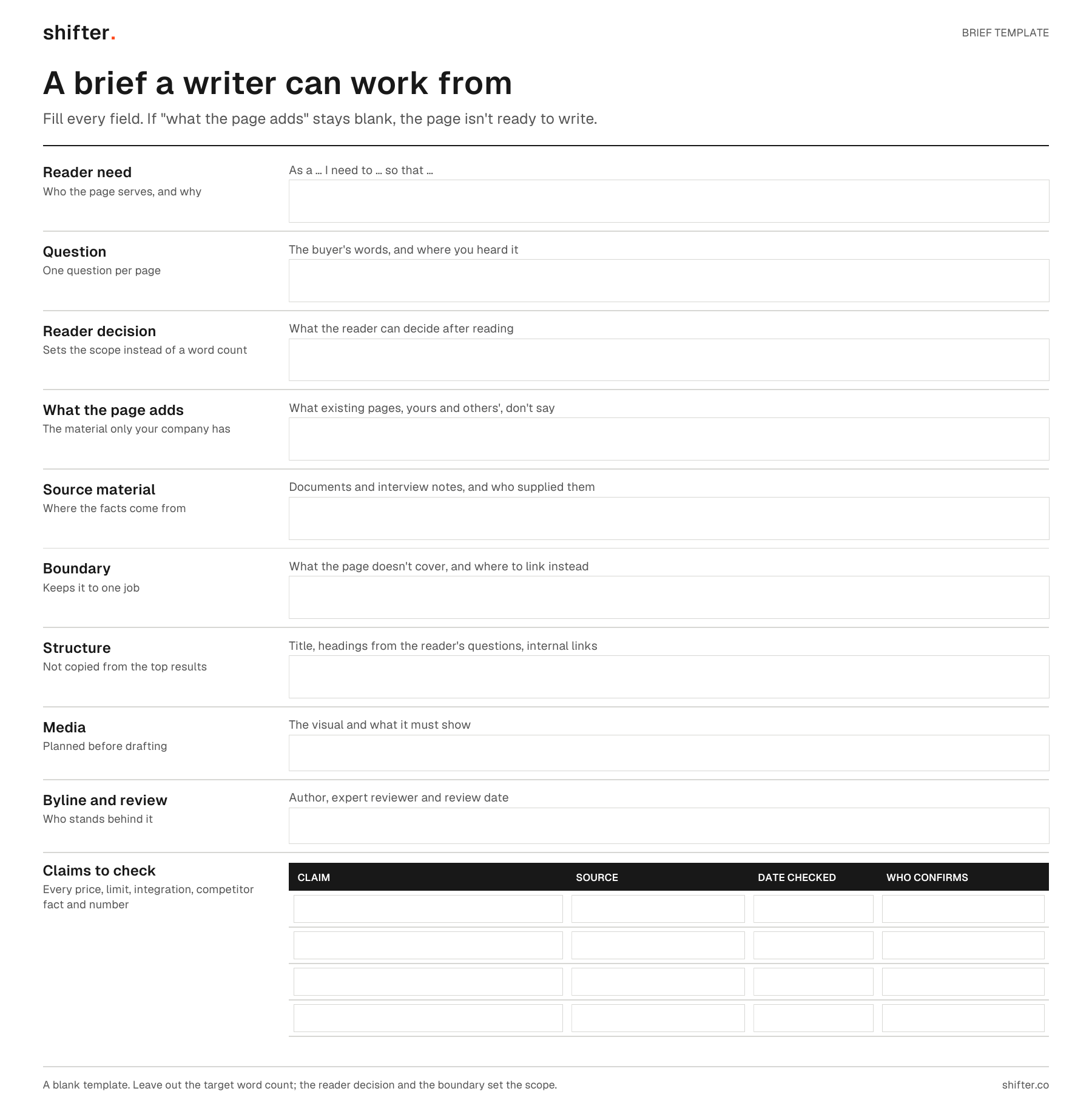
Read the visual as text
- Reader need: as a …, I need to …, so that … (who the page serves, and why).
- Question: the buyer's words and where you heard it (one question per page).
- Reader decision: what the reader can decide after reading (sets the scope instead of a word count).
- What the page adds: what existing pages, yours and others', don't say. If it stays blank, the page isn't ready to write.
- Source material: documents and interview notes, and who supplied them.
- Boundary: what the page doesn't cover, and where to link instead.
- Structure: title, headings from the reader's questions, internal links.
- Media: the visual and what it must show. Byline and review: author, expert reviewer and review date.
- Claims to check: a table with claim, source, date checked and who confirms, for every price, limit, integration, competitor fact and number.
The fields a writer needs
| Field | What to write |
|---|---|
| Reader need | As a [reader], I need to [task], so that [reason]. |
| Question | The one buyer question the page answers, in the buyer's words, and where you heard it |
| Reader decision | What the reader can decide after reading |
| What the page adds | What existing pages, yours and others', don't say |
| Source material | Documents and interview notes, and who supplied them |
| Claims to check | Each claim, its source, the date checked and who confirms it |
| Boundary | What the page doesn't cover, and where to link instead |
| Structure | Title, headings that follow the reader's questions, internal links |
| Media | The visual and what it must show |
| Byline and review | Author, expert reviewer and review date |
Reader need. GOV.UK's content standard says "Every piece of published content should meet a valid user need," and writes each need in three parts: "As a…", "I need to…" and "So that…". GOV.UK. Borrow it.
Question. Google says ranking starts with working out the intent behind a query. Google. Give each brief one question and its intent. Other phrasings of that question belong on the same page, since "a high quantity of pages doesn't make a website higher quality or more relevant to users." Google Search Central.
What the page adds. Google's self-assessment questions include "Are you mainly summarizing what others have to say without adding much value?" Google Search Central. Name the addition in one line, such as a first-hand case nobody else has published. If you can't, the page isn't ready to write.
Claims to check. List every price, limit, integration, competitor fact and number. The FTC's small-business guide says that before a company runs an ad, "it has to have a 'reasonable basis' for the claims." FTC. Written for advertisers, the standard suits any product claim.
What to leave out
Drop the target word count. Google's AI features guide says "There's no ideal page length," and "You don't need to write in a specific way just for generative AI search." Google Search Central. The reader decision and the boundary set the scope. Build headings from your reader's questions, not the top results.
If an AI model drafts from the brief
A model needs the same brief a new writer does. OpenAI's prompting guide suggests a prompt answer "What should the model do, and what should the model never do?" OpenAI. The boundary and claims to check answer the second half. Google says generative AI can help "add structure to original content," and the brief supplies the original content. Google Search Central. Check your AI tool's data terms before pasting in internal documents or transcripts.
The brief format we use
Each brief for these guides has seven fields. Newer briefs also carry a source pack: each source, its page date and the exact quote it supports, plus a table of claims to avoid or hedge. Shifter wrote this brief on 21 September 2026 for its guide on what buyers need on a SaaS product page:
- Buyer question: What information should a SaaS product page give a potential buyer?
- Reader decision: What should we improve on the existing website before sending it more traffic?
- Treatment: Work through a clearly fictional B2B product: who it serves, job it handles, constraints, setup, credible evidence, pricing access and next step. Annotate a page with concrete missing information. Separate buyer-clarity hypotheses from verified AI/search prerequisites; no 'add this block and ChatGPT will recommend you' claims.
- Evidence: Google indexing/AI-feature guidance for technical statements; supplied product facts if using any real product.
- Media: a flat annotated product-page mockup, readable at mobile width, visibly marked as an example.
- Links: our service and method pages, and our guide to choosing an agency.
- Boundary: product-page clarity; comparisons and other page types have distinct later briefs.
The treatment line sets what to cover and what not to claim. How to tell whether you're buying useful content shows a brief checked through to acceptance.
A fictional example
A fictional expense-software company starts with this brief: "Keyword: expense approval workflow. 1,800 words. Cover what the top five results cover." The revised version:
- Reader need: As a finance lead at a company with several offices, I need approval rules for split receipts, so that no expense is approved twice.
- What the page adds: the product lead's answer on receipts in two currencies, which no public page covers.
- Claim to check: "Approval rules can be set per cost center." Source: help doc. Confirms: product lead.
- Boundary: not a setup guide. Link to the help doc instead.
FAQ
What should a SaaS content brief contain?
The reader and their decision, the one question the page answers, what the page adds, the source material, every claim to check with its source and owner, and what the page must not cover. Add headings, links, media and the byline.
Should a content brief include a target word count?
Not as a rule. Google says there's no ideal page length, and that you don't need to write in a specific way for its generative AI features. Let the reader decision and the boundary set the scope.
Can the same brief work for a human writer and an AI model?
Yes, if a colleague with little context could write from it. A model needs what a new writer needs, including the boundaries and the claims to check.