Insights · Content quality · October 2026
How to check AI-assisted content for product and factual errors
Your agency or a teammate drafted an article about your product with an AI tool. It reads well and goes live tomorrow. Before you approve it, check whether its product details and numbers are true. Confident sentences won't tell you.

Split the draft into single factual claims. Check each product fact against the live product or its owner, and each outside fact against a primary source a teammate opened. Reword each claim to what its source supports, or cut it. A model can screen a draft, but a person signs off every claim you publish.
Why a fluent draft can still be wrong
OpenAI describes hallucinations as "plausible but false statements generated by language models." OpenAI. Researchers who scored long AI-generated texts found "generations often contain a mixture of supported and unsupported pieces of information." Min et al., EMNLP 2023. A draft can be right in most sentences and wrong in one. A quick read misses it.
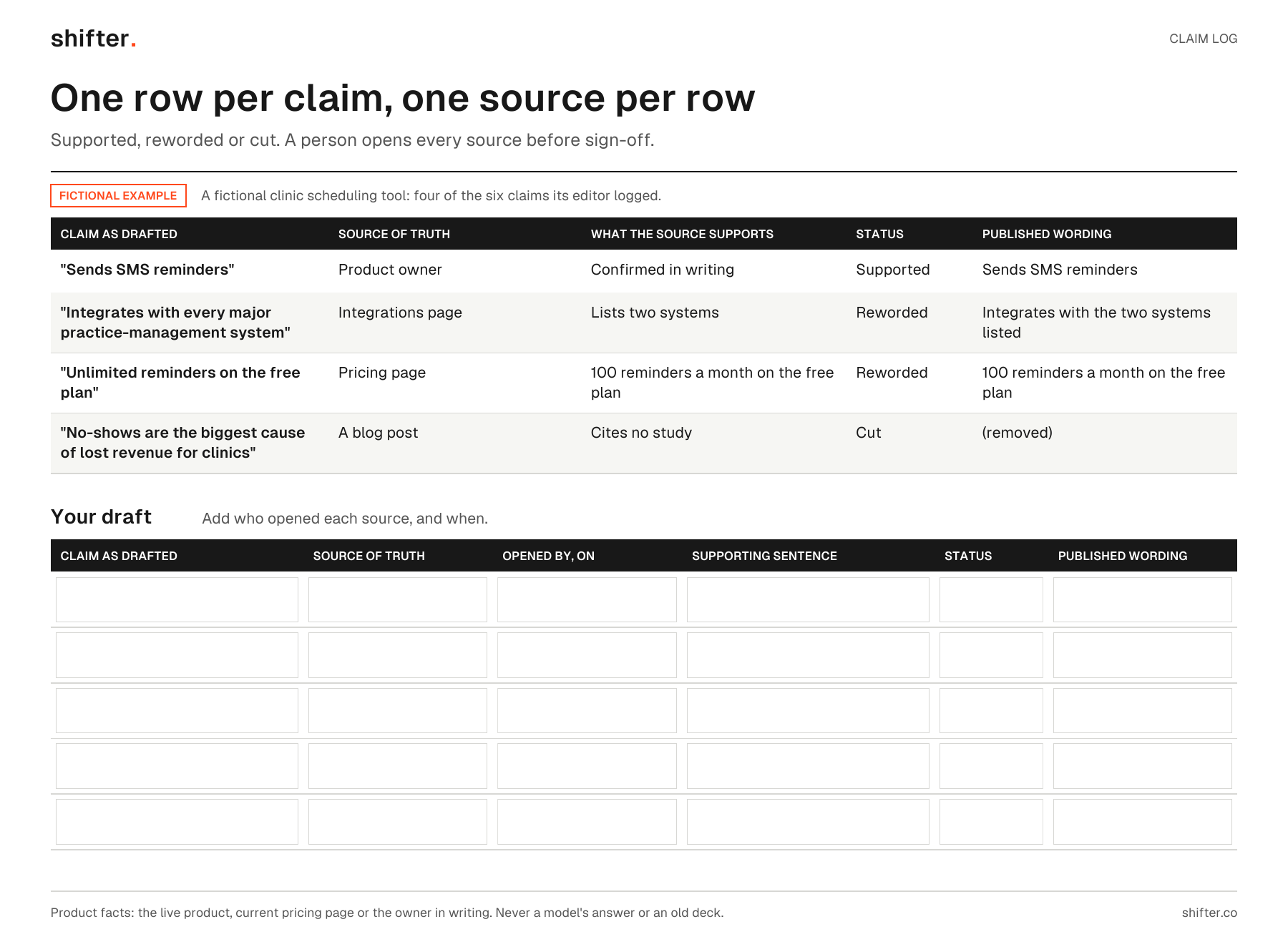
Read the visual as text
- Fictional example, a clinic scheduling tool: "Sends SMS reminders", confirmed in writing by the product owner, supported.
- "Integrates with every major practice-management system": the integrations page lists two systems, so it is reworded to the two systems listed.
- "Unlimited reminders on the free plan": the pricing page says 100 reminders a month, so it is reworded to that.
- "No-shows are the biggest cause of lost revenue for clinics": the source is a blog post citing no study, so it is cut.
- Blank fillable rows for your draft: claim as drafted, source of truth, opened by and on, supporting sentence, status, published wording.
- Product facts come from the live product, the current pricing page or the owner in writing, never a model's answer or an old deck.
What Google asks about AI-assisted content
Google doesn't ban AI-assisted drafting. It asks you to "focus on accuracy, quality, and relevance, especially when automatically generating the content." Google Search Central. Its self-assessment questions include "Does the content have any easily-verified factual errors?" Google Search Central.
In those pages, accuracy is a quality question. The spam policy on scaled content targets pages that add no value "no matter how it's created," and doesn't list factual errors as a violation. Google's spam policies. Whether a content program is worth paying for is covered in thirty articles a month.
Step 1: split the draft into claims
The method researchers use to measure factual accuracy "breaks a generation into a series of atomic facts" and checks each against a reliable source. Min et al..
Pull out every sentence that could be true or false: product facts, prices, dates, statistics, quotes, comparisons. Give each a row: the claim, its source of truth, who opened it and when, the exact supporting sentence, and a status (supported, reworded or cut). Opinions stay out of the table, but each needs a named owner. If you brief writers, list the claims to check in the brief (a SaaS content brief writers can actually use).
Step 2: check product facts against the live product
For your product, the source of truth is the live product, the current pricing page or the product owner's written confirmation. A model's answer, an old sales deck or a competitor's article doesn't count. Anthropic's commercial terms warn that outputs may not reflect recent events or information; a model can present last month's price as current. Anthropic Commercial Terms. Log the date you checked.
Step 3: open every outside source
Open every page the draft cites, including AI-suggested links. In a 2025 test of eight AI search tools, the Tow Center at Columbia Journalism Review found: "Generative search tools fabricated links and cited syndicated and copied versions of articles." Columbia Journalism Review.
A BBC and EBU study had journalists rate 2,709 answers to news questions from the free versions of ChatGPT, Copilot, Perplexity and Gemini. It found "45% of responses contained at least one significant issue of any type," and added: "Sourcing is the single biggest cause of significant issues (31%)." BBC and EBU, October 2025. Both studies tested news questions, not product copy. A citation is evidence only once someone has read the page.
Record the page's own date, or "undated, checked on" a date, and the exact sentence. For a study, note its sample and dates.
Step 4: use a model as a first pass
Anthropic's documentation suggests making a model find a supporting quote for every claim: "If it can't find a quote, it must retract the claim." Anthropic documentation.
This screen doesn't replace a person opening the source for every published claim. OpenAI's terms say: "You must evaluate Output for accuracy and appropriateness for your use case, including using human review as appropriate." OpenAI Terms of Use. Anthropic's terms say "factual assertions in Outputs should not be relied upon without independently checking their accuracy." Anthropic Commercial Terms.
Step 5: keep, reword or cut
Reword a claim to exactly what its source supports. Cut any claim with no source. For advertising claims about a product, the FTC's position is that "advertisers and ad agencies have a reasonable basis for advertising claims before they are disseminated." FTC Policy Statement Regarding Advertising Substantiation. The statement is written around consumer advertising and doesn't address business-to-business copy. This isn't legal advice.
A real example: our own fact-check log
Every guide on shifter.co goes through this check. The log for the eight guides we published on 25 September 2026 includes these three, each planned one way and published another:
| Guide | Claim we planned | What the source showed | What we published |
|---|---|---|---|
| Your first month with an SEO agency | Google's hiring guide gives a four-months-to-a-year timeline | Updated 5 June 2026, the guide no longer gives one | A timing quote from Google's SEO Starter Guide |
| What your SEO agency should hand back | A rule about Search Console owners | Our wording overstated the help page | The help page's own sentence |
| The access your SEO agency needs | Owners can add people without sharing a password | The help page doesn't say that directly | Only what the page says about adding users |
In the final check, 23 of the 25 linked quotes matched their source exactly; the checker had wrongly flagged the other 2. One quote with no source link became a paraphrase.
A fictional example: a clinic scheduling tool
A fictional scheduling tool for physiotherapy clinics gets an AI-assisted draft on reducing no-shows, and the editor logs six claims. "Sends SMS reminders" is confirmed by the product owner. "Integrates with every major practice-management system" becomes the two systems on the integrations page. "Unlimited reminders on the free plan" becomes the 100 a month on the pricing page. "No-shows are the biggest cause of lost revenue for clinics" links to a blog post citing no study, so it's cut. Two more claims are confirmed in writing.
FAQ
How should we review AI-assisted articles before publishing them?
Split the draft into single factual claims. Check product facts against the live product or its owner, and outside facts against a primary source a person opened. Reword each claim to what its source supports or cut it, and log who checked it and when.
Can an AI model check its own draft?
It can screen it. Anthropic's documentation suggests having the model find a supporting quote for each claim and retract any it can't support. OpenAI's and Anthropic's terms still put the duty to check output on the user, so a person should open the source for every published claim.
Who is responsible for a factual error in AI-assisted content?
Whoever publishes it. OpenAI's terms say users must evaluate output for accuracy, with human review as appropriate, and Anthropic's commercial terms say factual assertions shouldn't be relied on without independent checking. For advertising claims about a product, the FTC's standard is a reasonable basis before publication. This isn't legal advice.