Insights · Working with an agency · September 2026
Your first month with an SEO agency: what should be ready by day 30?
You've signed, and the first report arrives in 30 days. Rankings and traffic will barely have had time to move by then, so they can't tell you whether the engagement is on track. What should exist instead?

By day 30 you should be able to see five things: working access, a recorded baseline, a written plan with owners and dates, the first agreed work delivered and checked, and a first review where next month's priorities are decided. If any of these is missing, ask why before month two starts.
Why traffic isn't the day-30 test
Search results take time to respond to changes. Google's own guide says "some changes might take effect in a few hours, others could take several months," and that you "likely want to wait a few weeks to assess whether your work had beneficial effects." Google's SEO Starter Guide. Most of the first month's work only goes live in its second half, so a first-month report that leads with ranking gains is usually showing noise, a lucky query or work that started before the contract.
The first month is for setting up the work so the later months can be judged. You're checking evidence of work and of measurement, not results.
Read the visual as text
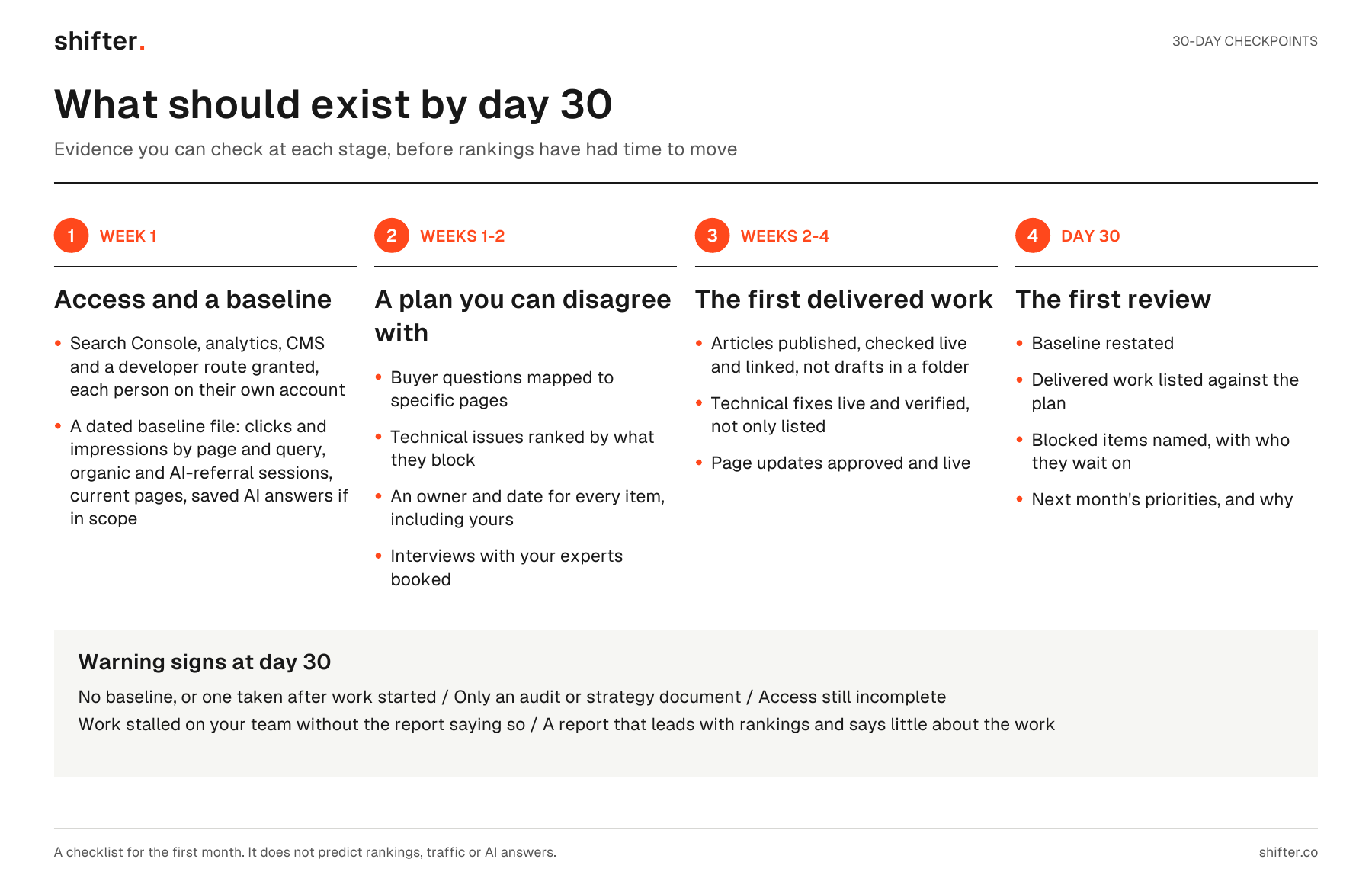
- Week 1, access and a baseline: Search Console, analytics, CMS and a developer route granted, each person on their own account. A dated baseline file with clicks and impressions by page and query, organic and AI-referral sessions, current pages, and saved AI answers if in scope.
- Weeks 1-2, a plan you can disagree with: buyer questions mapped to specific pages; technical issues ranked by what they block; an owner and date for every item, including yours; interviews with your experts booked.
- Weeks 2-4, the first delivered work: articles published, checked live and linked; technical fixes live and verified; page updates approved and live.
- Day 30, the first review: baseline restated; delivered work listed against the plan; blocked items named with who they wait on; next month's priorities and why.
- Warning signs: no baseline or one taken after work started; only an audit or strategy document; access still incomplete; work stalled on your team without the report saying so; a report that leads with rankings.
Week 1: access and a baseline
Access comes first because everything else waits on it. The agency needs Search Console, analytics, your content management system and a route for technical changes. The access and inputs your SEO agency needs lists them, with the permission level each role needs.
Then the baseline: a dated record of where things stand before any change. Ask for it as a file you keep, not a slide. It should include:
- Search Console clicks and impressions by page and query, for as far back as the account holds.
- Analytics sessions from organic search and AI referrals, by landing page.
- The pages that exist today, with their purpose and whether they're indexed.
- If AI answers are in scope, a fixed set of buyer questions asked on named engines, with the date, the mode and the answers saved.
Without a baseline taken before the work, month three's numbers have nothing to be compared against.
Weeks 1–2: a plan you can disagree with
Next comes a written plan. It should connect your buyers' questions to specific pages, new or existing, and rank the technical issues by what they block. Every item needs an owner and a date, including items assigned to your team.
A useful plan makes choices you can argue with: "we'll fix the pricing page before writing new articles, because buyers who reach it can't find the plan limits." A plan that lists every possible activity at equal priority hasn't made any choices yet.
Check what's in month one and what's deliberately left for later. Then check the dependencies: if the first articles need your product lead for a 30-minute interview, that should be booked now.
Weeks 2–4: the first delivered work
By the end of the month, some agreed work should be finished, not just recommended. What "finished" means depends on the scope you bought:
- Articles that are published, checked on the live page and linked from related pages, not drafts in a shared folder.
- Technical fixes that are live and verified, not a list of issues in an audit document.
- Page updates that went through your approval and are live.
If the contract counts delivery, this is where you check the count against the definition. Thirty articles a month shows how to test whether an article meets the bar you agreed.
Day 30: the first review
The first report should restate the baseline, list what was delivered against the plan and name anything blocked, with who it's waiting on. Then it should say what happens next month and why.
Consider a fictional first report. It shows eight of ten planned articles published, two waiting on product review, three technical fixes live and one blocked on developer time. It restates the baseline and proposes moving two topics up because early sales calls raised them. You can check every line of that, and it gives you something to decide.
Compare it with a report that shows a rising ranking chart for three terms nobody on your team chose, and no list of completed work. That one leaves you guessing about what you paid for. What your SEO report should show covers the format in more detail.
Warning signs at day 30
- There's no baseline, or it was taken after work started.
- The only deliverable is an audit or strategy document.
- Access is still incomplete, and nobody raised it.
- Work is stalled on your team, but the report doesn't say so.
- The report leads with rankings or traffic and says little about the work.
None of these means the engagement has failed. Each is a question to settle in the first review, while there's still time to fix the setup. If your contract includes a delivery guarantee, this is also when to check it. Traffic and delivery guarantees promise different things.
FAQ
What should happen during the first month of an SEO engagement?
Access should be granted and working, a dated baseline recorded and a written plan agreed with owners and dates. The first agreed work should be delivered and checked, and a first review should set next month's priorities.
How long does SEO take to show results?
Google's SEO Starter Guide says some changes take effect in a few hours and others take several months, and suggests waiting a few weeks before judging whether a change helped. A first-month report should show evidence of work and measurement, not ranking gains.
What should the first SEO report include?
It should restate the baseline, list the delivered work against the plan, name anything blocked and who it's waiting on, and say what happens next month and why.