Insights · Content planning · October 2026
When two articles answer the same question
Your blog has two articles that both seem to answer "how do we move our customer data from spreadsheets into a CRM?" One is two years old, the other from last quarter. Do they compete, and should one go?

Two articles compete when they answer the same question for the same reader at the same stage of buying. Write down what each page is for, then check what Google shows for each and whether it already treats them as one. Either keep both and make the difference clear, or merge them and redirect the other.
Two pages in the same results aren't automatically a problem
SEO tools call this "keyword cannibalization," a term the Google documents cited here don't use. Google says: "Some duplicate content on a site is normal and it's not a violation of Google's spam policies." Google Search Central. Bing agrees: "Duplicate content doesn't trigger search penalties on its own." Bing Webmaster Blog.
Google Search Advocate John Mueller replied to a question about this on his personal Bluesky account in September 2025: "But pages aren't duplicates just because they happen to appear in the same search results page." Bluesky. He posted personally; it isn't Google documentation.
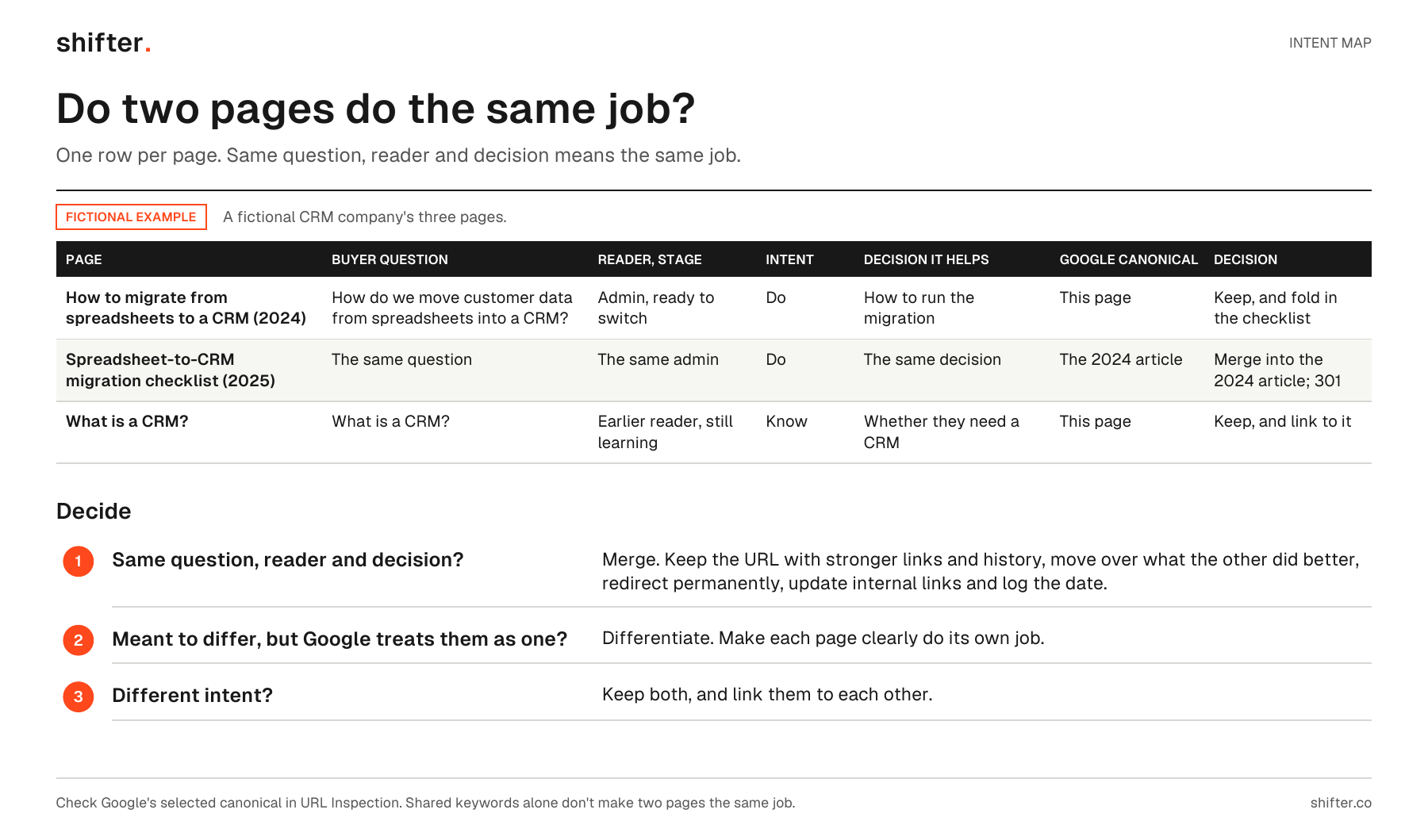
Read the visual as text
- Fictional CRM company. "How to migrate from spreadsheets to a CRM" (2024): answers how to move customer data from spreadsheets into a CRM, for an admin ready to switch, Do intent; Google canonical is itself; keep it and fold in the checklist.
- "Spreadsheet-to-CRM migration checklist" (2025): the same question, reader and decision, Do intent; Google chose the 2024 article as canonical; merge into the 2024 article and redirect permanently.
- "What is a CRM?": an earlier reader still learning, Know intent, helps decide whether they need a CRM; keep it and link to it.
- Decide: same question, reader and decision means merge (keep the stronger URL, move over what the other did better, redirect permanently, update internal links, log the date). Meant to differ but treated as one by Google means differentiate. Different intent means keep both and link them.
What it costs when two pages do the same job
When two pages do the same job, Google groups them and picks one: "If Google finds multiple pages that seem to be the same or the primary content very similar, it clusters them together." Google Search Central. Merging also lets you "consolidate the signals they have for the individual URLs (such as links to them) into a single, preferred URL." Google Search Central.
AI answers may pick one page too. Bing says: "LLMs group near-duplicate URLs into a single cluster and then choose one page to represent the set." Bing Webmaster Blog. It covers Bing's systems; we found nothing similar from other AI search providers.
Step 1: write down what each page is for
Make an intent map, one row per page. Google's rater guidelines supply the vocabulary: "It can be helpful to think of queries as having one or more of the following intents." Search Quality Evaluator Guidelines. For most B2B articles, two matter. Know means the reader wants information; Do means they want to get something done. The guidelines are for raters, not a ranking rule.
For each page, record the URL, the buyer question it answers, the reader and their stage of buying, the intent, the one decision it helps them make, the queries Google showed it for, its Google-selected canonical, and your decision. If two rows share question, reader and decision, the pages do the same job. Shared keywords alone don't.
Step 2: check what Google actually shows
In Search Console's Performance report, "Click a query in the table to filter all report data to the selected query," then "View the Pages tab to see which URLs were shown." Search Console Help.
Next, inspect each URL: "Inspect the indexed version of the page and look at the Page indexing > Google-selected canonical field." Search Console Help. If Google has chosen the other page, the Page indexing report says so: "Google has chosen the other page as the canonical for this page, and so will not serve this page in Search." Search Console Help.
The data is incomplete. "To protect user privacy, the Performance report doesn't show all data." Search Console Help. On a small site, the intent map tells you more.
Step 3: decide
Keep both when the intent differs, and cross-link them. A definition page and a how-to page can share keywords and still do different jobs.
If they should do different jobs but Google treats them as one, sharpen the difference. Google's fix is "ensuring that the pages that are clustered together are sufficiently different." Google Search Central.
Merge when question, reader and decision all match. Bing's rule: "Only keep separate pages when intent clearly changes." Bing Webmaster Blog. Keep the page with stronger links and history, move over anything the other did better, and redirect the retired URL permanently. Google calls a redirect "A strong signal that the target of the redirect should become canonical." Google Search Central. Update your internal links and log the date, because "Google might hold pages in a duplicate cluster for up to two weeks" after a fix. Google Search Central. Our guide on updating an existing page covers reworking the page you keep.
A real example: our own content inventory
While drafting these guides, we mapped shifter.co's 18 live articles and 8 new drafts against the buyer questions they answer.
First we compared every pair of live articles for shared five-word phrases. No pair shared more than 4%. Our own publishing rule holds a page for a rewrite or merge above about 40%.
The intent map found overlaps the text check couldn't:
| Pages | Overlap | Decision |
|---|---|---|
| Thirty articles a month and our guide on checking AI-assisted content for errors | The older guide lists the newer one's question as a supporting question and has an AI-assisted content FAQ | Keep both. The newer guide does the claim-level check, skips that FAQ and links back |
| How to choose the next six topics and our guide on updating a page | The topics guide answers "update or write new?" in a FAQ | Keep both. The FAQ stays short and links to the full guide |
| Our guide to choosing a B2B SEO agency and our 14-agency comparison | Both help a buyer choose an agency | Keep both. One judges proposals, the other compares named providers |
Once two pages share impressions for a query, the Pages-tab check above adds a third view.
A fictional example: two CRM migration articles
A fictional CRM company has "How to migrate from spreadsheets to a CRM" from 2024, a "Spreadsheet-to-CRM migration checklist" from 2025, and "What is a CRM?" The first two appear for the same migration queries, and URL Inspection shows Google chose the 2024 article as canonical for both. On the map they share question, reader and decision. The team makes the checklist a section of the 2024 article and redirects the 2025 URL. "What is a CRM?" serves an earlier reader with a Know intent, so it stays.
FAQ
Is duplicate content a Google penalty?
No. Google says some duplicate content on a site is normal and not a violation of its spam policies, and Bing says duplicate content doesn't trigger penalties on its own. Near-duplicates still get clustered, so overlap is worth fixing.
Should we delete the weaker of two similar articles?
If they answer the same question for the same reader, merge them instead. Keep the stronger page, move over anything the other did better, redirect the old URL permanently and update your internal links. Google treats a redirect as a strong signal of which page should be canonical.
Do AI answers pick one of two similar pages?
Bing says its AI systems group near-duplicate URLs into a cluster and choose one page to represent it. We found no similar statement from other AI search providers.